kuzma VS kuzma VS kuzma
In this test, we tried to conceive a duel with three contenders, hence the truel. Interestingly, a truel is also a game theory concept where three participants compete, often taking turns attempting to eliminate each other. The theory also says that the sharpest shooter is not always most likely to win. Strategy matters a lot. In this truel, none of it really mattered as whoever wins, is Kuzma.
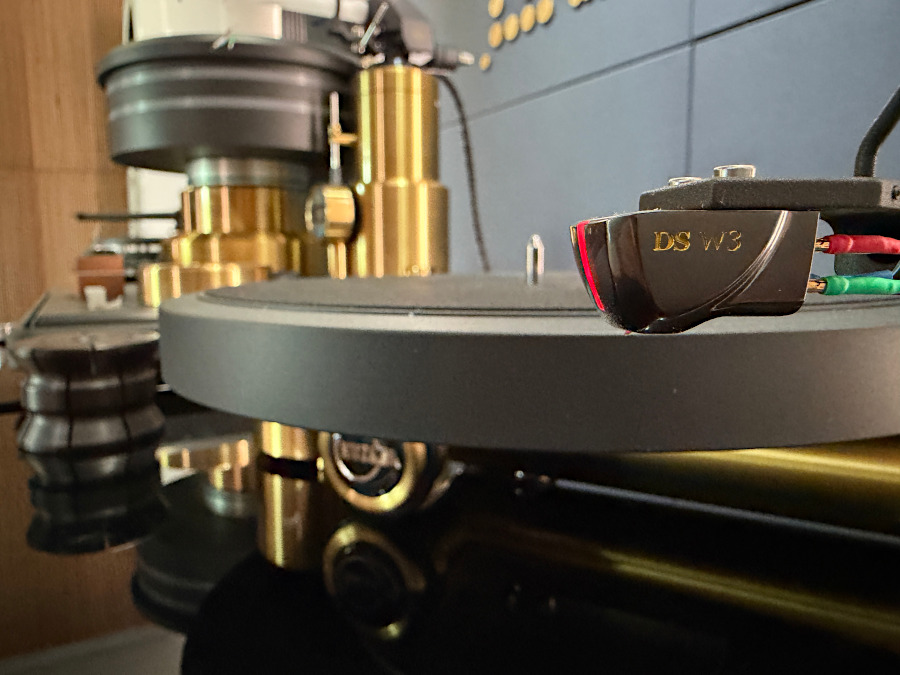
The Slovenian company first started production in 80’s and quickly became a legend, as they provided a fantastic price to performance ration right from the very beginning, with minimalistic and purely functional design. Since then, their portfolio has grown respectably, so have the prices. Yet, Kuzma belongs to the privileged club of the turntable manufacturers whose creations have never come out of fashion, also because the company is able to retrofit anything they have ever produced.
The truel
In Kuzma’s world, Stabi stands for stability, Stogi stands for rigidity. Although bearing the same family names, three very different set-ups were available:
Stabi S is Kuzma’s entry level turntable, introduced already in 1998. It was also one of the first turntables (together with Rega) that came to my audio radar in late 90’s. The Stabi’s chassis is based on 50mm solid brass rods clamped to each other in a T shape. that provide stability, rigidity and damping. The motor is housed independently in its own brass cylinder and drives the subplatter with a flat belt. The bearing is of highly polished, fine grain carbon steel with a one-point contact, while the bearing sleeve is of a resin/textile material which has excellent damping, non-resonant properties. The main 30mm platter is aluminium, damped with a rubber insert underneath. The turntable comes with a stylish acrylic cover that is open to all sides so is of no use if dust is your main concern. The Stabi S has no levelling options, the brass rods rest on rubber O-rings, so must make sure the surface underneath is perfectly level.
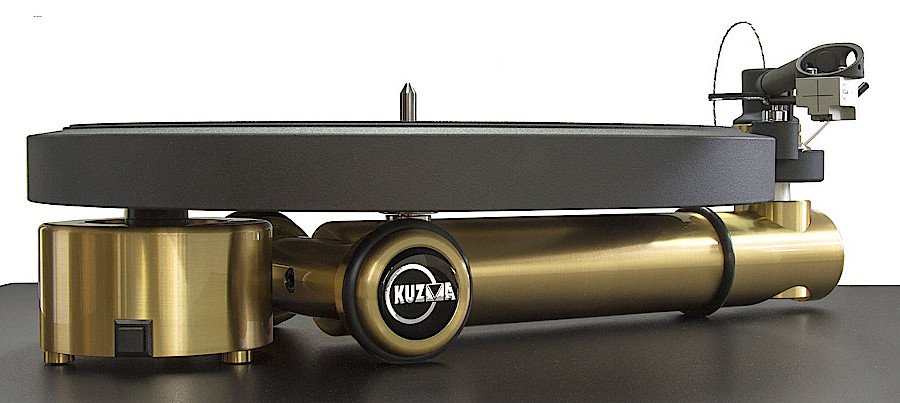
The reviewed unit came with an outboard powers supply, hence the “S PS” denomination. It was equipped with Stogi Ref tonearm with a conical aluminium tube. Kuzma says that resonances are suppressed via 3 strategies: brass segments, glued parts, and selective anodization to break up resonance modes build up. VTA adjustment is made by raising or lowering the tonearm in the arm base itself. The tonearm can be used in an XLR balanced or a 5pin configuration.
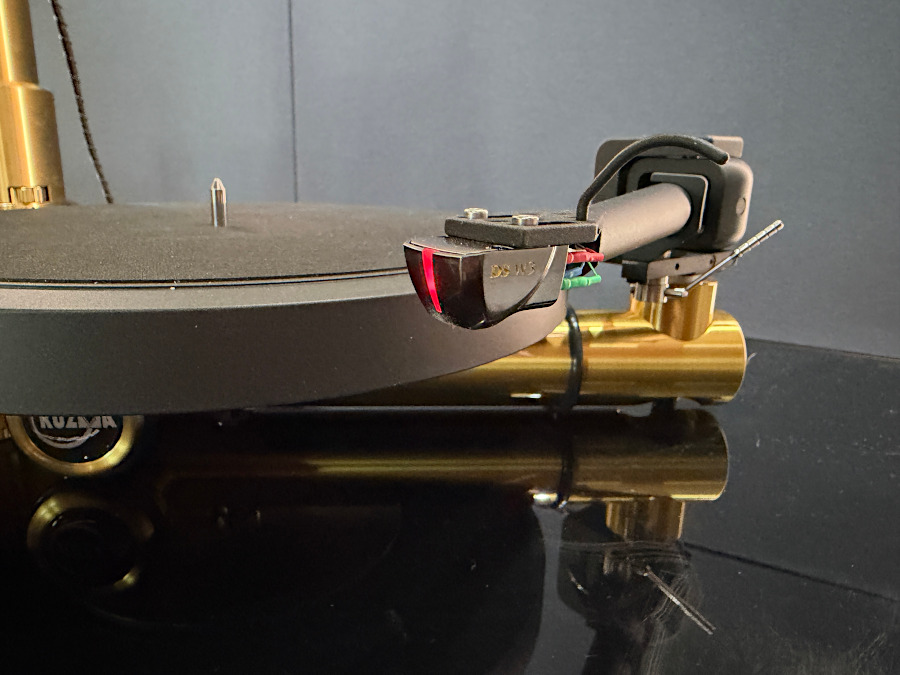
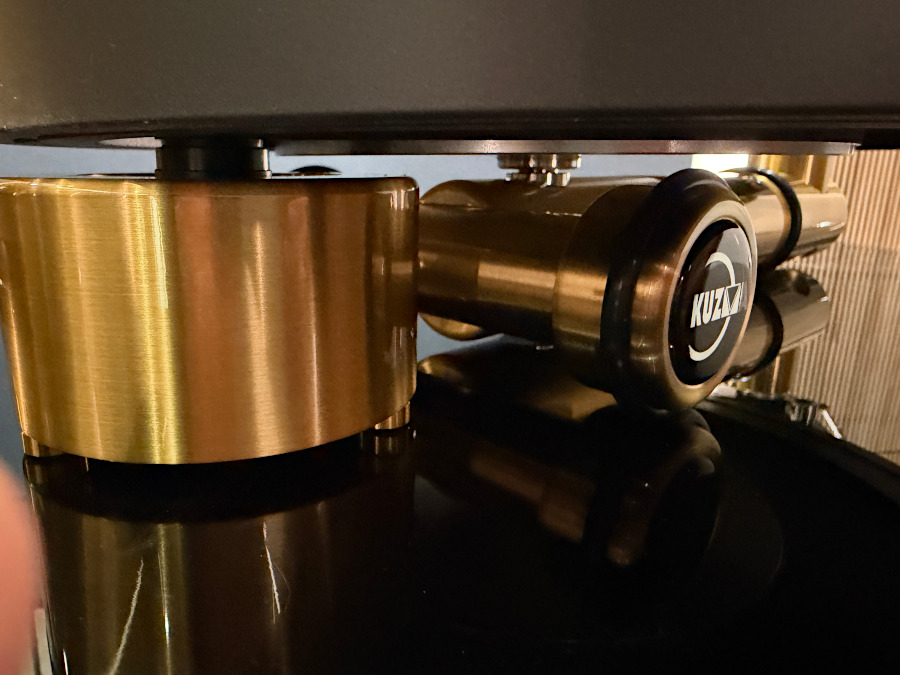
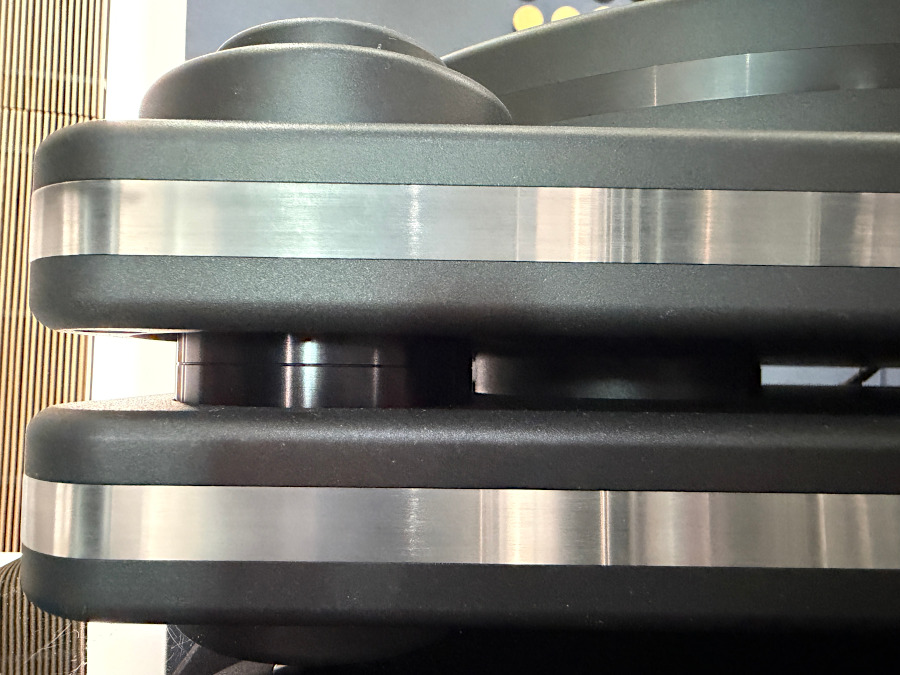
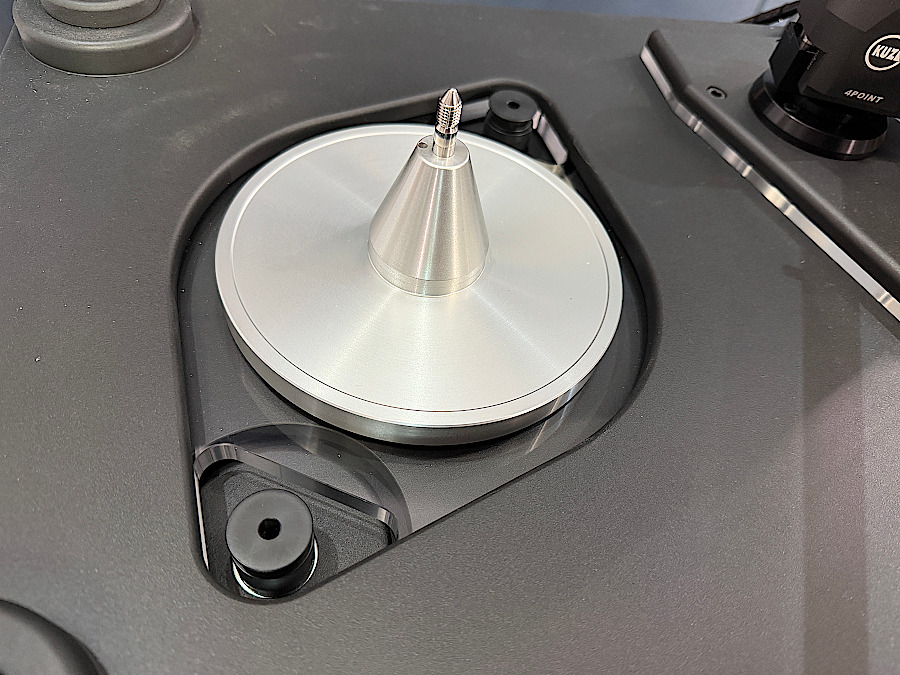
The original version of the Kuzma Stabi Ref is from 1992 and the Ref 2 version differs with PS Ref 2 power supply. The turntable is constructed from two plates, each plate being made from a sandwich construction of two 10mm aluminium plates, separated by an acrylic plate clamped together with pre-stressed non-magnetic screws. The turntable chassis (top plate) is suspended by large springs submerged in silicone oil, with a low resonance of 2.2Hz, which dampens movements of the springs themselves. The main base (bottom plate) is supported by three aluminium and stainless-steel spikes. The top plate is levelled by four knobs.
The platter and the armboard are also clamped aluminium and acrylic sandwiches.The subplatter on ruby ball bearing is driven by two motors with flat rubber belt.
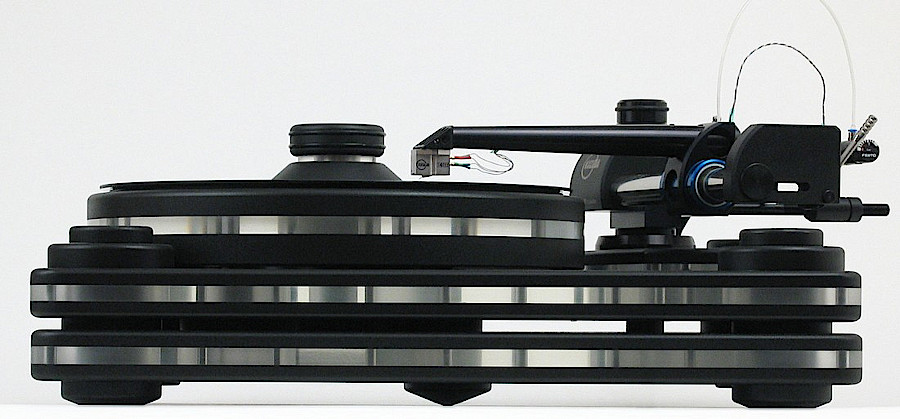
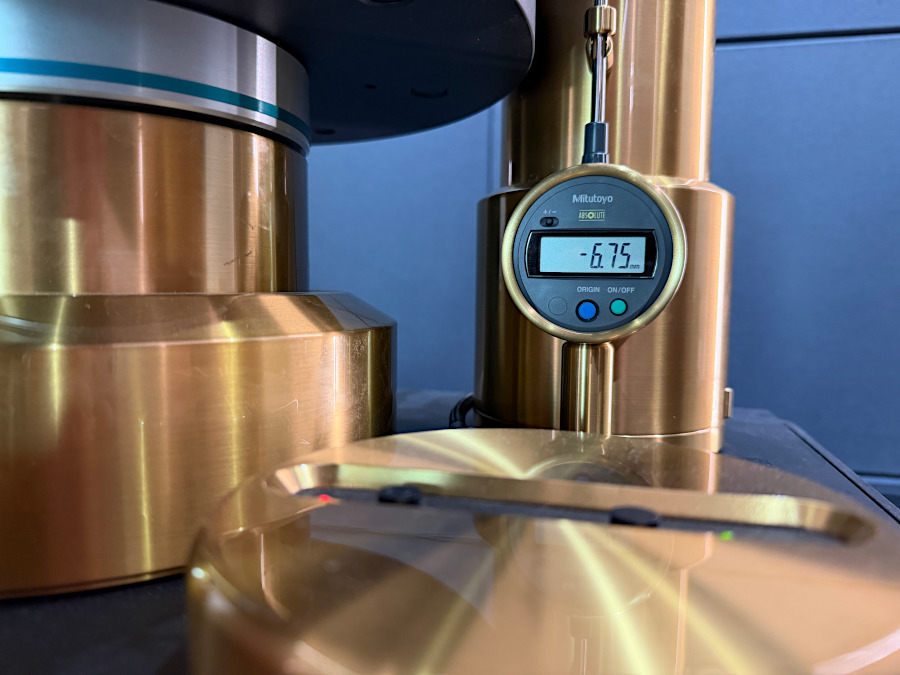
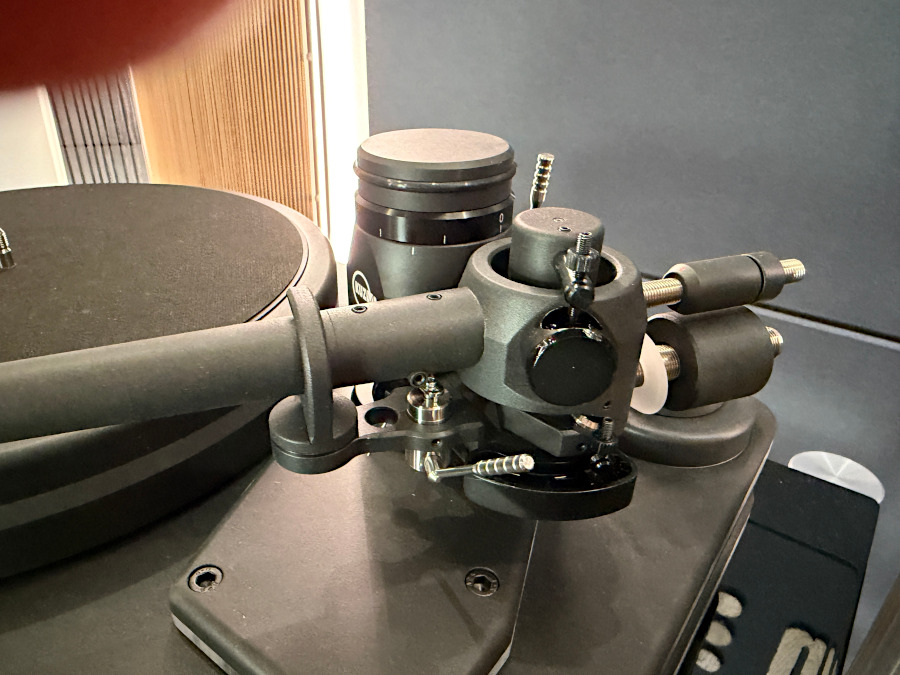
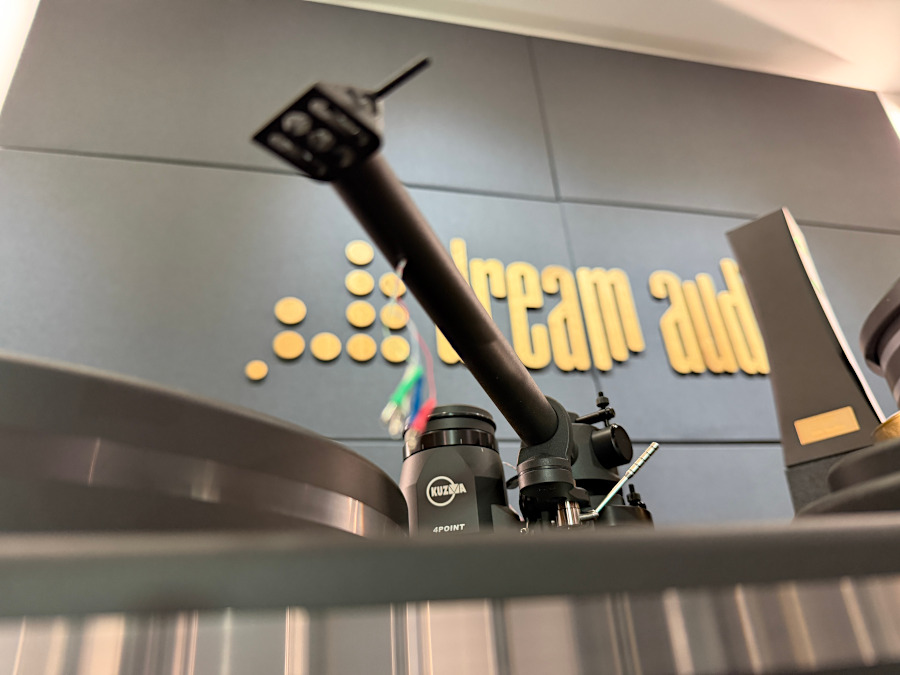
The 4Point 9 tonearm is machined from aluminium and has sets/couples of bearings: one for vertical movements and one for lateral movements. All four points of the bearing have minimal friction and zero-play in all planes of movement, thus ensuring that the cartridge platform and the cartridge itself follow the grooves of an LP with extremely low friction and minimal vibrations. The main section of the tonearm is firmly connected to a very rigid and inert VTA tower which provides the option of fine adjustments of the vertical tracking angle either when the tonearm is stationary or while the LP is playing, with 0.01mm accuracy.
The 4Point’s balancing mechanism consists of two counterweights – the main weight allows an accurate overall balance once the cartridge has been installed, while the second, smaller weight provides extremely fine further adjustment for total tracking force accuracy. Azimuth is adjustable by precise worm drive mechanism allowing very small, repeatable adjustments. Using an Allen key, one can completely remove the headshell from the arm tube while the arm silver alloy wiring including cartridge pins remains uninterrupted in its single run. The headshell is fixed with a hexagonal locking system which provides the same degree of rigidity as if the headhsell was permanently bonded to the arm tube.
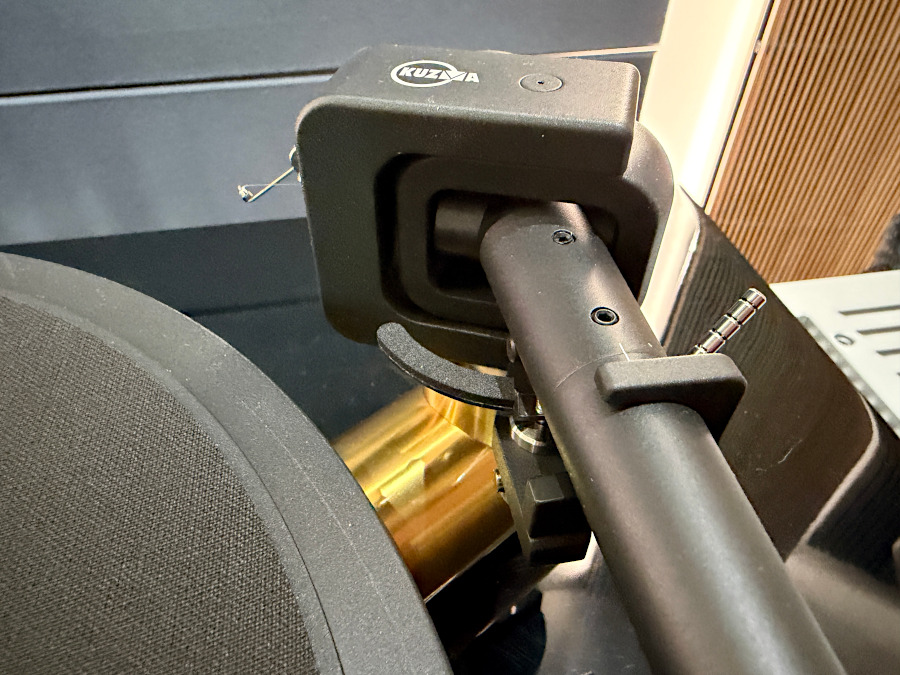
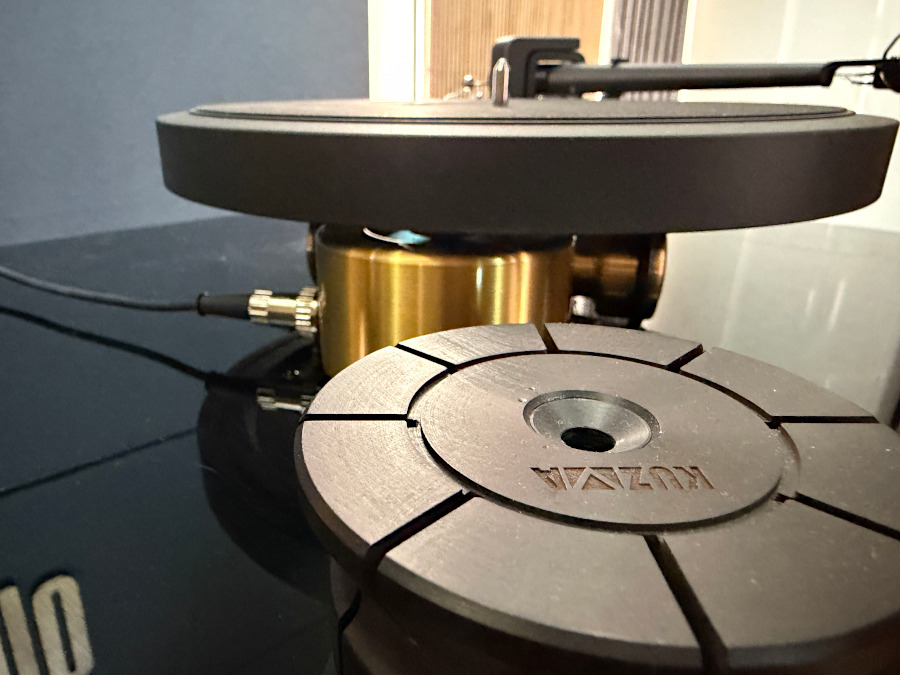
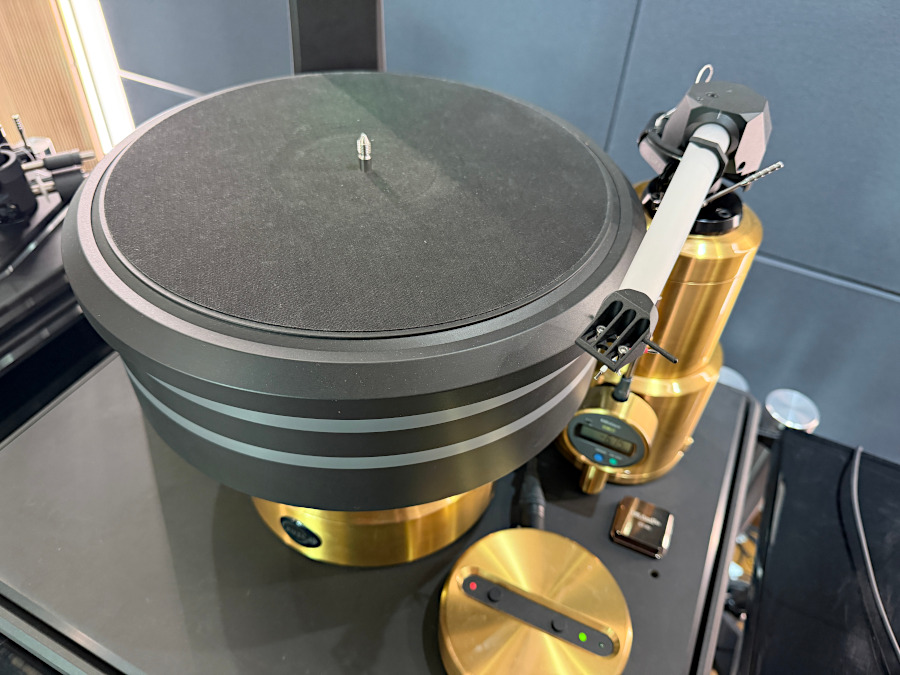
The Kuzma Stabi XL DC is a 68kg brass monster. The platter chassis, the motor, and the tonearm towers are completely separated for breaking any resonance bridge between the three. While it uses similar materials (sandwiched acrylic and aluminium, bronze segments, ruby bearings) the monumental platter weighs 23kg on its own. While the previous two tables operated with 33 and 45rpm speeds, the XL DC allows also for 78rpm, which probably won’t matter much if you are a modern music listener, but it will if you are into some rare early stuff.
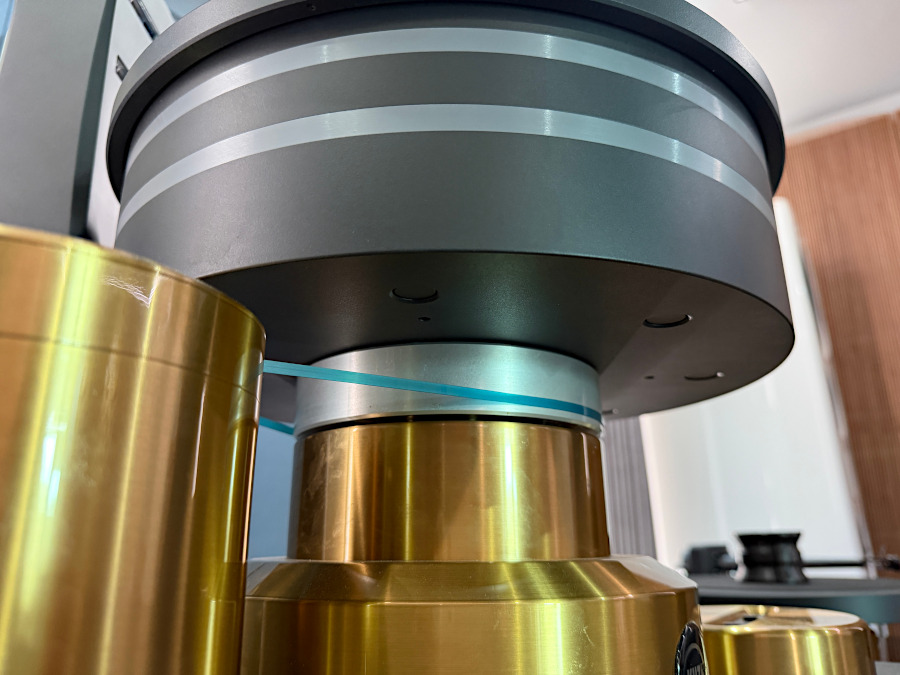
Interestingly, the DC upgrade of the original XL introduces just a single DC motor and a power supply and a special polymer belt which won’t remain unnoticed due to its bright blue colour. Kuzma suggests that the belt’s lack of elasticity is key to maintain established distance between the motor pulley and the subplatter, thus less speed fluctuations. One can argue that less elasticity also means more vibration transfer, but this seems not to be an issue.
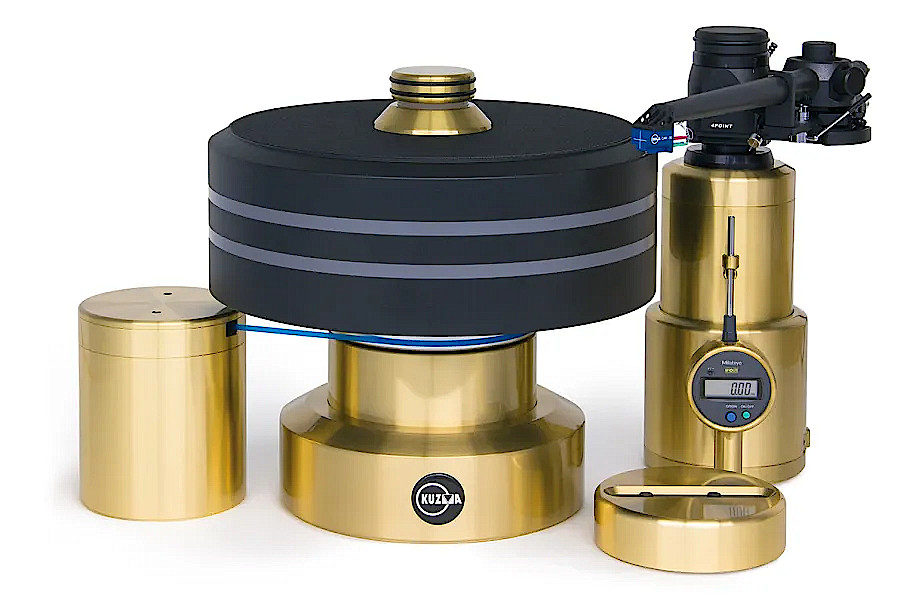
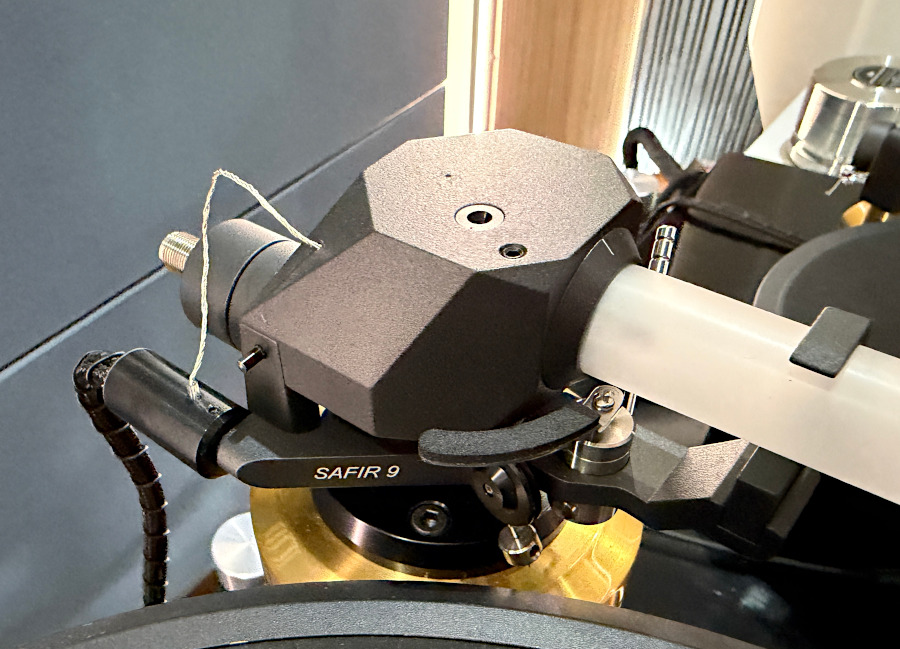
The XL DC was equipped with the best tonearm that the Slovenian manufacture has ever produced – the Kuzma Safir 9. The heart of the tonearm is a very rigid sapphire conical tube that is fitted into massive block of solid aluminium and brass, giving inert support and serving as a vibration dissipating block. The internal wiring is silver alloy. The tonearm bearings are of a unique design of 4 spikes set in sapphire cups similar to those used in the 4Point tonearm. All four points have minimal starting and moving friction and zero play in all directions thus ensuring that the headshell with the cartridge moves precisely and with minimal vibration across the record. VTA is adjusted by raising or lowering the tonearm’s pillar in the arm base with a VTA screw which controls its height, thus still allowing precise VTA adjustments. As with any other toneram, the set of wires runs with no interruption from cartridge pins to RCA connectors. For Safir, the connectors are pure silver.
For all the Kuzma turntables, combined with any Kuzma tonearm, adaptors are available. Should you have a different preference and want to use a tonearm from a different manufacturer, just ask Kuzma and they will adjust the turntable for it.
The method
To compare the three Kuzma gramophones, I decided to start with the most affordable one and creep up to the most expensive one, then creep back again. I usually find the latter part to be more interesting - the ears (at least mine) are more sensitive to what becomes missing from what I heard before. This type of subtractive listening is also much more efficient if you need to compare several products at your dealer’s shop. Of course, it is also the most dangerous way for your bank account. But not always and this test is a good example of it.
I chose 4 cuts from Burmester’s Selection Vol.1 LP sampler (INAK 78041LP) – Al Di Meola’s And I Love Her, Domenico Scarlatti’s Sonata K406 in C Major interpreted by Christian Zacharias, Amber Rubarth’s Full Moon in Paris, and Ella Fitzgerald duet with Louis Armstrong in Can’t We Be Friends.
Each turntable was set up and calibrated carefully before listening with exactly the same cartridge (DS Audio W3). While the Stabi XL DC is visually rather intimidating and induces a fear of “I will never be able to set it up properly by myself”, it was the Stabi Ref 2 turntable that was the trickiest to work with due to its wobbly chassis sandwich. At home, it is going to be a set & forget process, but for this test, with some time limitations, we spent an hour before the Ref 2 was dialed to perfection.
The listening
Through the Stabi S PS, the Christian Zacharias’s piano has a “sparkling” quality, like water gurgling over rocks in a mountain stream. The space around the instrument’s soundboard is beautifully audible, individual notes are superbly defined, and—especially at the left end of the keyboard—the strings under the hammers and the nuances of the keystrokes come through very nicely.
With the Stabi Ref 2, the contrasts between quiet and even quieter passages on the same track are audibly better illuminated. The microdynamics are excellent—obviously, from an analog perspective, where some of it is inevitably eaten up by groove noise. This adds another dimension to the listening experience, giving you the feeling that you can see the fingertips on the keyboard. And if I previously used the adjective “sparkling” to describe the Stabi S PS, I would now call it “dancing.” Rhythmically, the Stabi Ref 2 is more engaging and sonically more sophisticated. This is even more evident with the Al Di Meola’s piece, that truly blossoms with the Ref 2. While the strings were lively yet less metallic with the Stabi S PS, the Stabi Ref 2 provides a crystal-clear distinction between wood and metal. The sound in the room takes that magical leap from listening to a record on a turntable to listening to a performer standing in the room right in front of you. Or at least it comes very close to it. Besides suddenly having a concert at home, the elevated dynamic perspective translates into a different level of listening comfort, as if the sound were more cushioned, less sketchy, and had greater flow.
The upgrade from the Stabi Ref 2 to the Stabi XL DC is a classic high-end move, in the sense of diminishing returns. In other words, for significantly more money, we get more sound, but not proportionally. However, this applies to virtually any audio component. To my ears, the most significant difference lies in the more accurate focus of the sound—instruments and their spatial relationships are more precisely defined, and there is a wider range of tonal colours. This is likely due to better separation from groove noise, which reveals previously inaudible details. This is beautifully audible in the gentle opening of Full Moon In Paris, where suddenly more is to be heard, as well as in the singer’s pronunciation, where “tonigh” becomes a perfectly clearly articulated “tonight.” It also feels as though we’re playing 1–2 decibels louder with the exact same volume settings and the same cartridge.
Soundstage
With the Kuzma Stabi S PS, the violin, cello, and singer were effortlessly located in a quasi-realistic soundstage. However, I found the voice rather lacking in depth—that sense that the there is a 3D head behind the voice. It worked similarly with Ella Fitzgerald, where the 3D effect in the voice was also absent; in plain language, the illusion of the singer in the room wasn’t holographic. When the cartridge was moved to the 4Point 9 tonearm on the calibrated Ref 2 at the same volume and with the phono stage set identically, the voice suddenly became a part of a person. The Stabi Ref 2 has a lower tonal center of gravity, and with a significantly lower noise floor, it sends a range of new cues to the ears that are important for reconstructing the object in all three dimensions.
The overall atmosphere of the recording also changes. As we climb the Kuzma quality ladder, the accompanying orchestra in Can’t We Be Friends emerges from the background and, instead of merely providing a backdrop, becomes an equal partner to Ella and Louis. The piano, double bass, and the rhythm section’s brushes are suddenly beautifully defined; the soundstage is more cohesive and relaxed. If I asked myself whether such an experience would prompt me to switch from digital to analog, I would answer no, but if I had the Kuzma Ref 2 + 4Point 9 + DS Audio system at home already, I probably wouldn’t feel any urge to switch to digital either. While I may have some reservations about the technical aspects of the sound, this is generously compensated for by the analog pleasure. The top model in the test, the Stabi XL DC, doesn’t make a dramatic difference. Everything described above comes into play, so we get objectively better sound, but I wouldn’t say that the overall enjoyment increases massively beyond what the Kuzma Stabi Ref 2 is already capable of in this configuration.
Variables
It’s important to realize, however, that I listened to predefined combinations of turntables and tonearms. This makes sense from the buyer’s/user’s perspective; so the questions remain: what would happen if I mixed and matched the tonearms? And what if you took a completely different tonearm, and a different cartridge, and a different slipmat, and a different phono preamp, and a different rack…? As usual, the possibilities are endless.
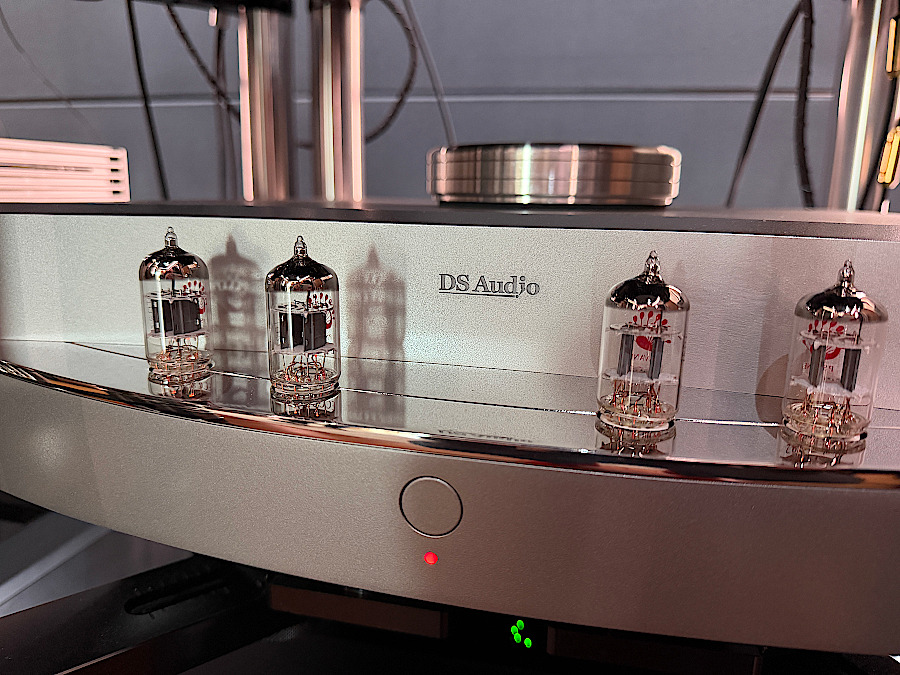
Both companies involved in this test have more tricks up their sleeves. DS Audio sells ION-001 ioniser that generates positive and negative ions to neutralize and is said to remove the static charge from vinyl records caused by friction of the stylus during record playback, as well as induced by removing records from the sleeve. At approximately €1800, it is rather expensive. Yet, if you are convinced that your analog rig is dialed to perfection, its effect is nicely additive. That is: more perfect perfection. The sound as if was facelifted, it has better immediacy, inner organization, as is more solid overall. Actually, it is very easy to hear the difference, it is not just an imagination. Yet, the scale and value of it will be very individual.
Kuzma offers an interesting alternative/addition to a usual central record clamp The Kuzma Outer Bronze Ring clamp (€2700) has inner diameter of 316mm and weighs 1.3kg. It presses the circumference of a vinyl record down to the platter, thus “flattening” it and stabilizing it. Added weight must be also counted in as it increases the flywheel effect for added speed stability. This is a purely mechanical solution to removing unevenness and resonances, and I love the simplicity of the idea. At this price point, it is not cheap, but you can view it from the perspective of what you’d pay for 2-3 1st vinyl presses. Similar peripheral clamps are offered by VPI Industries and Clearaudio, however the fact that the Kuzma’s is made of bronze rather than steel makes it quite outstanding.
To wrap it up, each of the tested turntables will occupy the top echelons of their category. Although each is of a very different concept, a T-bar chassis vs a floating chassis vs a completely decoupled chassis, they bear family resemblance – a composed, clear, accurate and entertaining sound. If you do not have generous budget, then the entry-level model will provide hours of listening pleasure. If you have too much money, then you will not be satisfied with anything but the most expensive models – at least that’s how brains of my richer audiophile friends work. However, for me, the combo of Kuzma Ref 2 + 4Point tonearm represents a catalogue sweet spot, a gate to truly high end music playback.
Associated components:
- Sources: Kuzma Stabi S PS / Stogi Ref tonearm, Kuzma Stabi Ref 2 / 4Point 9 tonearm, Kuzma Stabi XL DC / Safir 9 tonearm, DS Audio W3 cartridge
- Amplifiers: Ypsilon PST 100 MkII SE Anniversary preamplifier, Ypsilon Orion mono power amplifiers, DS Audio TB-100 phono
- Loudspeakers: Revival Audio Atalante 7 EVO
- Interkonekty a reprokabely: Stage III Concepts Ckahron + Cerberus
- Power conditioning: Stage III Concepts Leviathan + Proteus, DS Audio ION-001Ionizer
https://www.kuzma.si
Distributor: Dreamaudio, Bratislava, Slovakia, +421 907 838 806
Prices as reviewed:
€5 100 Stabi S PS
€12 600 Stabi Ref 2
€37 800 Stabi XL DC
€4 400 Stogi Ref
€8 800 4Point 9
€22 200 Safir 9
(C) Audiodrom 2026