SNDSTG LOCꓘ
A leap in time and place. June 2007, Concertgebouw, Amsterdam, and Stravinsky’s The Firebird (RCO Live), Mariss Jansons. The soundstage is luxuriously deep, the clarity across the instrumental sections unique, with all images locked in place, dramatic fortes, and silky pianissimos. At times it’s mind-boggling—hardly can I keep track of the individual musicians as they pass their parts to one another, the scene insights are so ridiculously precise. The winds are not less phenomenal, coming from the right perspective above the heads of the others, from a specific spot in the orchestra. Moreover, it practically doesn’t matter whether I’m playing quietly or loudly. Loud—by which I mean an average volume of 94.7 dB at the listening position. The SNDSTG LOCK seems to work better than I expected.
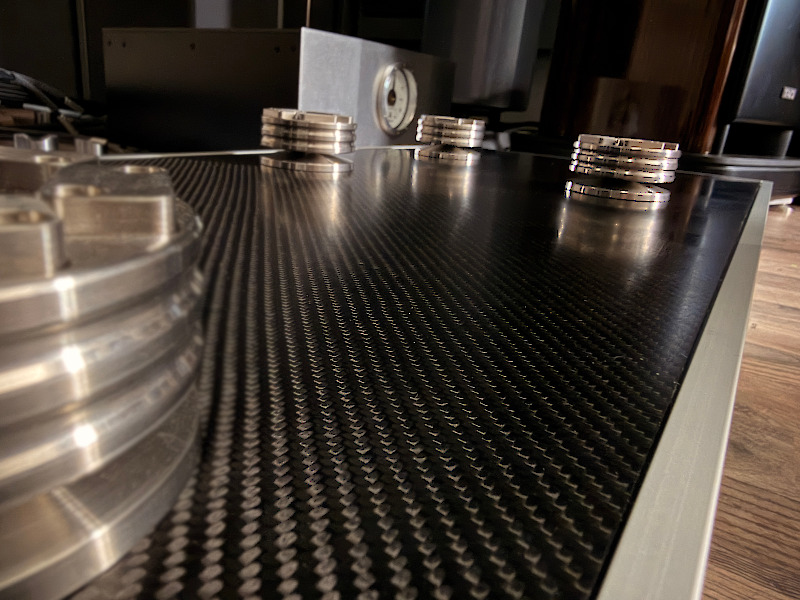
SNDSTG LOCK: Lock the image. Unleash the music.
Never touch anything in the audio system if it performs great. Can it perform even better? That’s something that never comes out of our minds. That’s why we do touch our systems. It is the Catch-22 implementation in practice.
A Catch-22 is an impossible, circular problem where you cannot escape because the rules or conditions make a solution dependent on the problem itself. The phrase comes from the same-titled novel by Joseph Heller. In the book, military pilots can be excused from dangerous missions only if they are declared insane. However, asking to be excused shows a rational concern for one's own safety. That rational concern proves the pilot is sane. As a result, the pilot must keep flying. It is an endless circle.
I have been building my own system over long years and any change, no matter how small, moves it out of balance and I need to work hard to establish the equilibrium again. True, then it becomes better than before; why would I perform the change after all, wouldn’t I? But it is one step back and two steps forward. I hate stepping back; I hate all the effort I need to expel again to get where I already was before I can surpass it.
So, when I sort of decided to make a bold move and replace the platform on which my audio components rest, it meant disturbing literally everything. And no way I could restore the original platform as I had to dismantle it completely.
SNDSTG LOCK: Ideation
I spent about a month researching the platforms that exist in the market, trying to correlate their building logic with my own experiences. I have not tested them all but spending time in person with the likes of HRS (Harmonic Resolution Systems), Symposium Acoustics, Synergistic Research, Solid Tech, and Stillpoints, distilled into one single conclusion: whatever you buy will work, but the result depends heavily on the type of the floor, on the weight of components, and the load distribution. This way, what sounds bright in one system, sounds overdamped in another. Ultimately, it comes down to a trial-error approach aimed at finding the platform that will hit the sweet spot. Keep this in mind if, for example, you decide to copy/paste the design of my SNDSTG LOCK; yours may use the same principles, but it may use different materials, material thicknesses, and dimensions.
Although I have a technical background, it would be silly not to employ AI engines. I needed to reiterate through so many changes and ideas that I’d spent easily a year with such a job if I didn’t. I must say that using the AI models that are available for free (typically Gemini and other basic engines) yields, well, mediocre results. So, I moved to professional paid AI tools. As an obsessive maximalist, I employed two of them and cross-feed them with information to see how convergent they are. Often, one suggested subtle improvement that the other disapproved or endorsed.
It was a really interesting process, driven by data like material composition of my floor, and the parameters of the components that should rest on the platform. Ultimately, there was also the ‘unmeasurable, subjective, and romantic’ part of the project, an aspiration to achieve this type of sound:
- Deep, tight and fast bass with no boom
- Sharp transient attack and alive presentation, with maximized micro- and macro-dynamics
- Stable and accurate soundstaging, precise image contours with instruments and voices ‘locked-in’ with no bleeding and smear
SNDSTG LOCK: Realization
The platform is designed as a heavy, asymmetric, constrained-layer-damped structure for power amplifiers and a digital player. Its purpose is not to “isolate” the equipment with a soft suspension as it is the worst thing (although the most intuitive thing) you can do. Instead, the design combines a rigid equipment interface, high distributed mass, viscoelastic shear damping and a controlled termination into a floating laminate floor. The whole platform weighs slightly over 110kg.
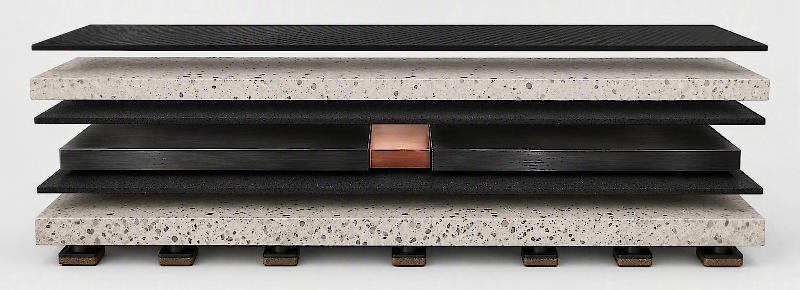
The Lock in exploded view.
The SNDSTG LOCK's final architecture is simplistic, as you can see from the exploded view. The design intent is mechanical stability and faster decay of platform resonances. Claims such as tighter bass or more stable imaging should be treated as system-dependent outcomes, not guaranteed material properties. The objective of engineering is repeatable vibration control.
- Top skin is a thin layer of carbon fiber composite used for surface stiffness, load spreading and durable finish.
- Upper slab is made of marble conglomerate. It serves as a rigid equipment-bearing plate and upper constraining layer.
- Upper damping layer, Comfortmat Volt, represents a viscoelastic shear layer.
- Mass layer is the heaviest: Two steel and one copper slabs, create concentrated mass and a central constrained layer.
- Lower damping layer uses the same material as the upper damping layer with the same purpose – to be a second shear-damping interface
- Lower slab is marble conglomerate, heavier than the upper slab to create a stable base, load distribution and low-frequency inertia.
- Floor interface is 10 pads of calculated thickness, hardness, and placement, for controlled contact with the floating floor.
Deliberately, I am not stating thicknesses and precise specifications of the materials. My platform has been tuned precisely to my conditions and preferences; yours may be radically different. Still, you can use exactly the same architecture if you wish, as it works better than expected, as you will learn later further in this article.
Material considerations
The marble conglomerate was chosen for great stiffness with useful internal loss. Similar composite is used by e.g. Estelon to cast their speaker cabinets. I needed something dense, dimensionally stable and more uniform than natural stone, and not ringing like any type of wood or metal. I originally thought Corian slabs could be the best choice, but after some initial tests it seemed to be on a bit overdamped side due to the high content of resin and too fine mineral part. Solid marble is not a bad choice either, but it rings. In the marble conglomerate, the resin phase and distributed stone grains interrupt the uninterrupted crystalline path found in solid marble. This makes the conglomerate less prone to a clean, high-Q “ring” than a homogeneous stone slab and not so damped as Corian. The visual aspects were not important; the slabs are not visible. If you want a great performing and cheap material, go for thick birch plywood panels.
The thickness asymmetry is deliberate. The thinner upper slab limits unnecessary mass above the damping core, while the thicker lower slab creates a stable base and spreads the central concentrated metal loads into the support pads. The lower slab also provides a robust handling surface, important because the completed assembly will be extremely heavy.
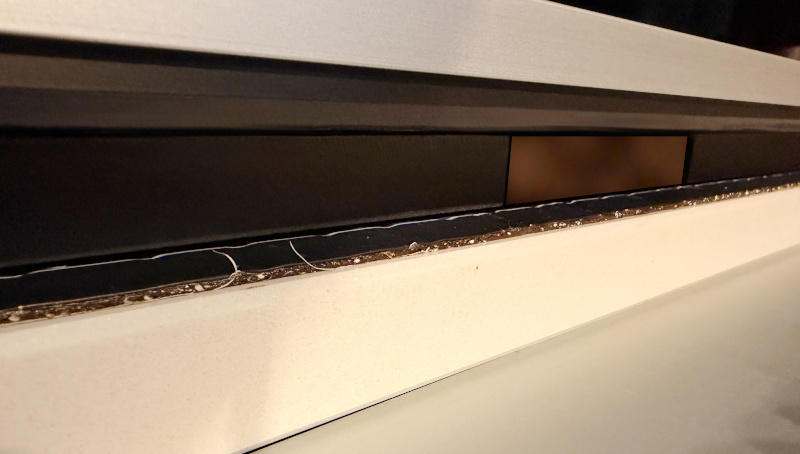
"Naked" Lock without the final decor.
Segmented steel and copper provide altogether approximately 60kg of mass. The metal plates occupy most of the platform length but remain physically separate. Segmenting the mass layer avoids creating a single resonant mode. The gaps are therefore not wasted space; they represent a necessary structural discontinuity and must not be rigidly bridged.
Damping layers are an active loss mechanism. The Comfortmat Volt is a great lossy automotive sandwich. It works when deformation of the rigid layers produces shear inside the viscoelastic compound. For that reason, full contact and perfect adhesion are essential. The self-adhesive face should be applied to clean, degreased conglomerate (whole length of it) and rolled firmly to exclude air. The opposite face must also hold in continuous, high-pressure contact, here ensured by the heavy marble conglomerate slabs.
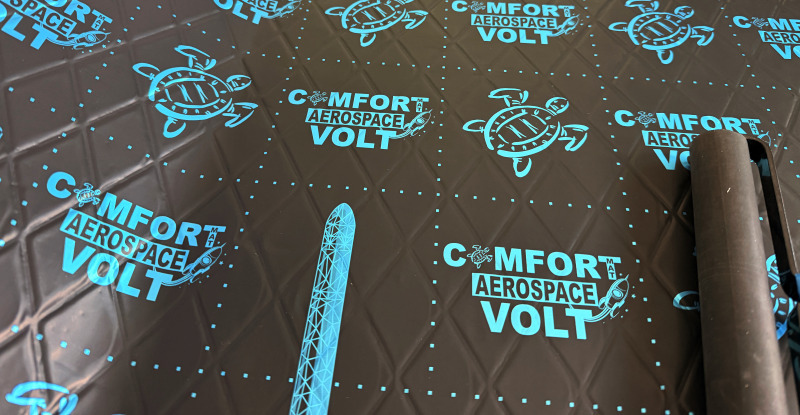
Comfortmat Volt is a pliable material with reliable self-adhesive layer on it. It is pleasure to work with it.
Top composite skin is sort of optional and a great fine-tuning element. There are many options, each working a bit differently and each looking a bit different. As the top plate is what you see as your audio components will rest on it, the visual element should not be neglected. There are only three rules of thumb: the top skin must be thin (0.5-4.0mm, depending on your goal), it must not be soft, and it must be planar. The rest is very tunable. The easiest is to use aluminum, bronze, or copper sheets, although I would not recommend any metals as they may couple with electronic circuits and transformers in unpredictable ways. Then there are hard wood veneers; strictly speaking, none of them will be sonically neutral, and they tend to change colour and wear off over time. I skipped them. From three best materials that remained on my shortlist, carbon sheets, carbon laminates, and HPL sheets, I chose the carbon laminate, as it can be both thin and self-damping better than pure carbon. HPL sheets are another great option, but not easily obtainable in the rather small format I needed. In the case of the SNDSTG LOCK, the carbon laminate is a secondary skin, not the main damping element. Its value is surface hardness, local load distribution and increased bending stiffness of the upper slab. The skin is a thin full area 2K epoxy interface with the top marble conglomerate slab. For successful application, the conglomerate slab must have been sanded until it was perfectly flat, degreased, and the epoxy had to be applied in as thin and even layer as possible and cured for two days.
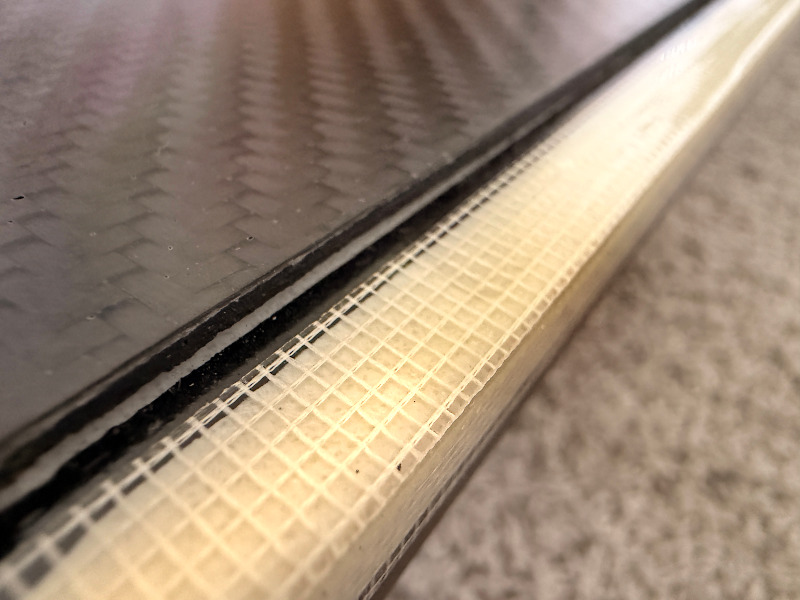
The carbon composite top skin. The network that you see is a part of 3M tape that was used to attach aluminum profiles during the final step.
The floating laminate floor is the least predictable part of the system. The pads must carry the entire platform and equipment load without rocking, excessive creep or hard bottoming. Shore hardness alone is not enough to select a pad. Compound type, compressive modulus, allowable pressure and long-term compression set matter. In plain language, if you, for instance, replace a lightweight integrated amplifier with a heavyweight one, then you may replace your calibrated pads with different ones. Too soft and they will bottom and lose their function; too hard and they will not be elastic enough to work. Too thin and the compressive modulus is gone, too thick and the pads will become energy storage reservoirs and enemies of sound of your system. My 10-pad coordinate plan was asymmetric to prevent resonant modes, but it also needed to provide stability.
The strongest version of the design is not the one with the greatest number of materials. It is the one with flat rigid layers, a genuinely bonded viscoelastic shear core, uninterrupted support beneath the upper slab, a preserved steel-plate discontinuity and pads selected from real load data. Execution quality will dominate small differences in nominal thickness.
The final touches were purely decorative. It took a lot of measurements, calculations, and preparations upfront so that the materials as described above are cut to the sizes that would later fit to commercially available aluminum profiles. From the whole sandwich, only the very top carbon skin is visible.
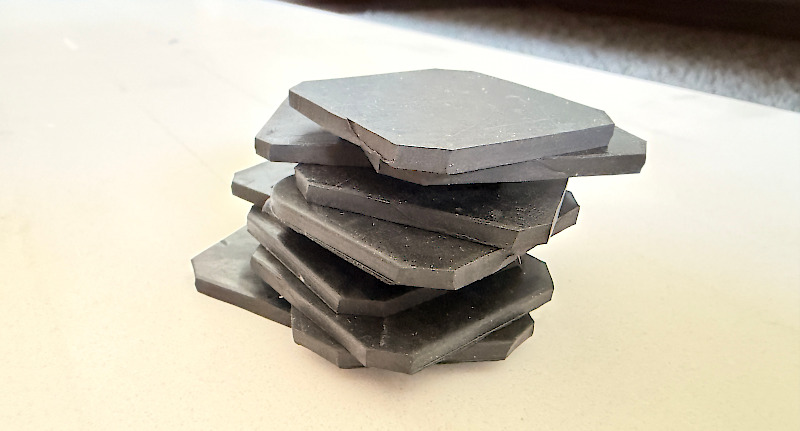
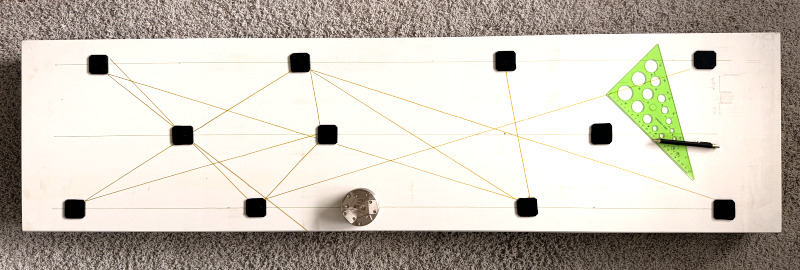
The assymetry in pads coordinates is not random; it was calculated to avoid build up of resonant modes.
SNDSTG LOCK: Sound
Since completely overhauling the anchoring of the entire system is a radical change, I was quite worried about the outcome. So, I took a gradual approach and started with non-musical material to prevent early disappointment —specifically, the LEDR test from Nordost’s System Set-Up Disc. The LEDR represents a very useful tool. These computer-generated noises were primarily created to assess listening environments (hence LEDR, Listening Environment Diagnostic Recordings); they are sounds that move in symmetrical paths up and down, laterally, and in arches between and behind the loudspeakers. The paths should be smooth and continuous; if they are not, it means that you need to move your speakers, move your listening chair, rebuild your acoustics, or rebuild your system. I have been using the LEDR for last twenty years and the SNDSTG LOCK makes a huge difference to what I’m hearing.
For example, I always used to have very good in the “Up” test results, with the path just slightly trending towards the axis of the room, like 20°, as the sound approached the ceiling. It sort of makes sense for my ceiling is not flat (check the Audiodrom Reference Room article). However, with the SNDSTG LOCK in place, the vertical paths have become straight, floor to ceiling. Ditto the lateral and arched tests delivered superb results with uninterrupted and tonally stable paths of the chuffing noise.
Another great soundstaging test comes from Sheffield Lab’s A2TB Test CD. Tracks 27 to 32 are one continuously paying dynamic song, that in intervals switches from full stereo to only the left and only the right channel, to mono, and back to stereo. With the SNDSTG LOCK, I have the narrowest central mono phantom in my life. Primarily, this is achieved by good speaker placement/toe-in, but now, without platform’s “ringing”, the central image was precisely occupying the very narrow line in front of me.
The soundstaging miracle continues with real music. The opening moments of Hotel California from the Akapellando album are nothing short of mesmerizing. With the SNDSTG LOCK, all vocalists appear with an almost uncanny sense of physical presence, suspended freely in space with laser-sharp localization and an uber-stable image. Instead of sounding like a recording reproduced by loudspeakers, the performance unfolds as a three-dimensional acoustic event. The voices become men in my room, surrounded by palpable air and naturally rendered ambience. Every inflection, breath and harmonic nuance emerge with startling clarity, yet without a trace of artificial edge or analytical exaggeration.
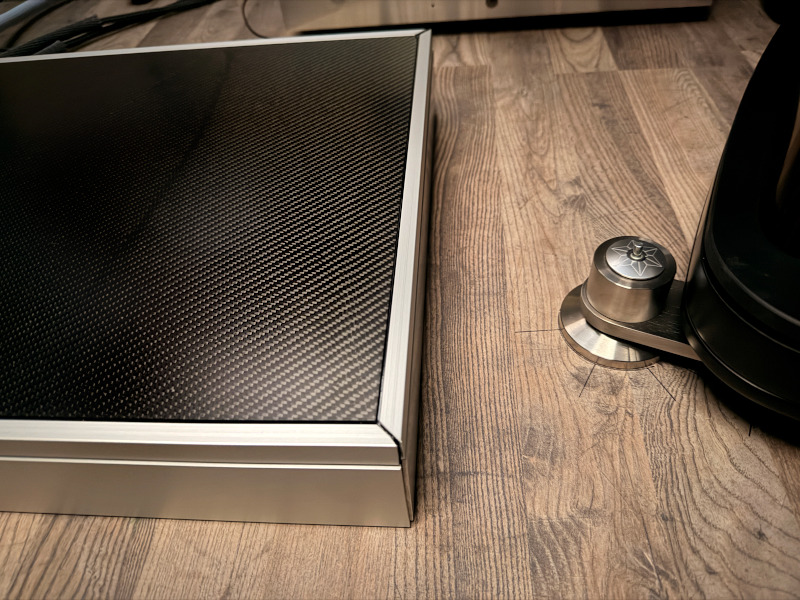
The Lock dressed-up. Aluminum profiles come from the nearest home depot store.
What impresses me most is the liquidity and depth of the soundstage. The vocal ensemble creates a vast and holographic acoustic scene with continuous rather than layered depth.
The platform seems to remove any veil of low-level smear, allowing the complex interplay of voices to separate effortlessly. Instead of a flat left-to-right presentation, the stage develops genuine triaxial perspective, and the result is a very visual listening experience, where spatial cues become so convincing that the room becomes irrelevant.
Equally remarkable is the tonal realism of the human voice. The platform brings an exceptional sense of body, texture and harmonic richness, preserving the individuality of each singer while maintaining perfect coherence of the ensemble. Voices sound fuller, more vibrant and more lifelike, yet remain perfectly controlled. Transients are instantaneous, dynamic contrasts startlingly realistic, and the silence between notes appears darker and quieter. Hotel California becomes less a test track and more a demonstration of just how convincingly a carefully engineered support platform can unlock the spatial, tonal and dynamic potential already hidden within a recording. Speaking about the transients and dynamic contrasts, in the first minute of Keith Don't Go of Nils Lofgren, the guitar attack has much more immediacy and presence. The opening string strikes emerge from a pitch-black background with explosive transient energy, yet without ever sounding hard or aggressive. Every pluck carries its own distinct leading edge, followed by a rich bloom that seems to hang effortlessly in space. Again, the guitar is not just positioned between the loudspeakers; it occupies a perfectly defined three-dimensional space. Also, the audience is no longer perceived as a distant wash of people, but as a collection of individuals embedded within a coherent venue. Applause, small noises and hall reflections emerged from precise locations, creating an extraordinary feeling of being transported into the performance.
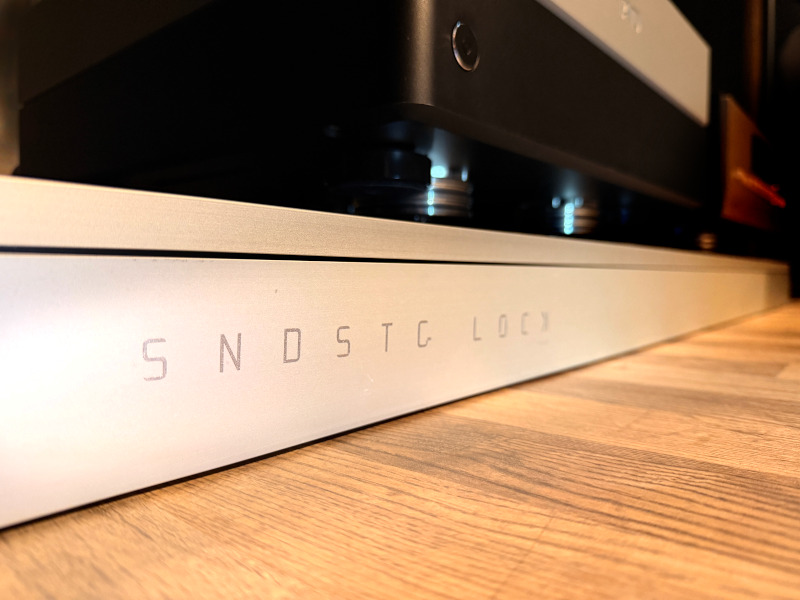
Front view of the SNDSTG LOCK. It delivers stability, depth, and precision to music.
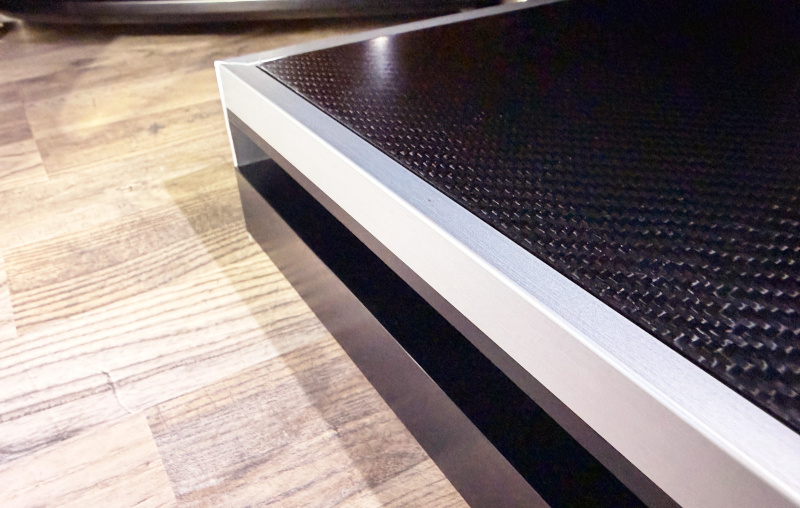
... And the rear view of the same.
SNDSTG LOCK: The project assessment
As far as the budget is concerned, the project cost me circa 600 euros in material costs, and approximately 5 days to put everything together. It is very cheap by any audiophile standards. And the improvement can be compared to successful acoustic treatment.
What I am getting from the SNDSTG LOCK is unprecedented stability, depth, and precision in imaging, much cleaner decays, elevated instrument separation, better dynamics and transient attack, and, as a result, also tighter and punchier bass. The ability to play louder is another, albeit unexpected, outcome.
It is precisely projects like these that restore my faith in high-quality engineering—as opposed to the “magical” technologies that are so in vogue these days and that cannot be explained to the average layperson because they are the secret knowledge of designers, acquired from a higher dimension.
(C) Audiodrom 2026