GRIMM AUDIO PA1
Power amplifiers
“There’s nothing to discuss—she’s standing right there,” my friend declared. By “she”, he meant Cassandra Wilson, and I could only agree: through the pair of PA1s, the illusion of her presence in the room was utterly convincing. The rest of the listening session followed in much the same vein, with frequent shakes of the head (“Is this really possible?”), but above all, smiles - because it was.
Function and form
The Grimm Audio PA1 is a solid-state monaural power amplifier operating in Class AB; a stereo system requires two separate units. Its fully symmetrical circuitry is based on a circuit design developed by Henk ten Pierick in 1985, reflected in the PA1 designation, which stands for ‘Pierick Amp’.
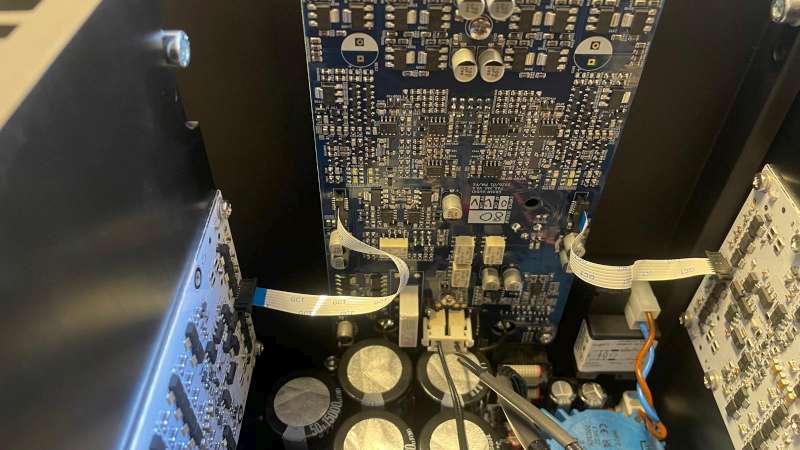
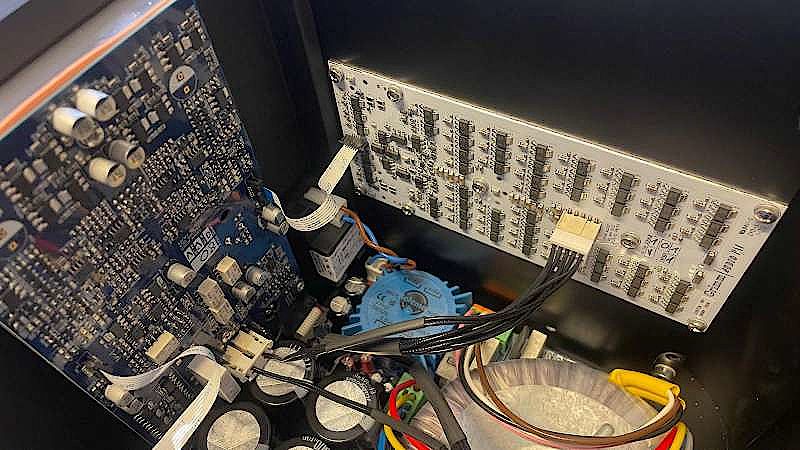
At the forefront of the design, Grimm Audio focuses on minimizing the overall harmonic distortion to the level below 0.0001%. They employ several mechanisms: a flat feedback up to 20kHz so the gain is constant and does not emphasize any frequency in terms of distortion; they reduce thermal distortion by mounting the driver stage and the output stage on an aluminium-backed printed circuit board that is tightly attached to heatsinks, so the thermal bridges are constant and so is heat dissipation; and finally, the power - the manufacturer specifies the output power of 200 W into 4Ω - is distributed over 96 (!) fast bipolar transistors. The idea here is that the bipolar device performance is very dependant on the thermal performance and capacitance values and not having it under control modulates phase behaviour, to which human ear is extremely sensitive. I like this very technical and no-nonsense approach, especially because listening to the PA1 confirms the correctness of choices.
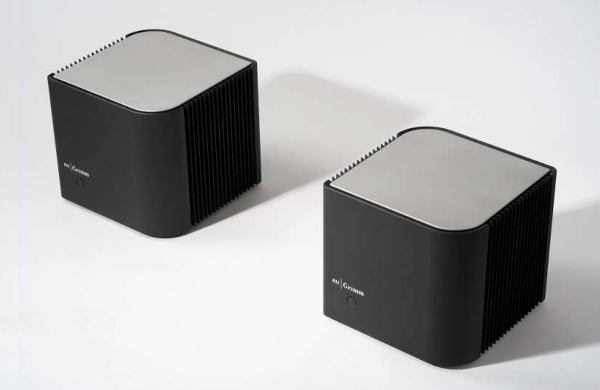
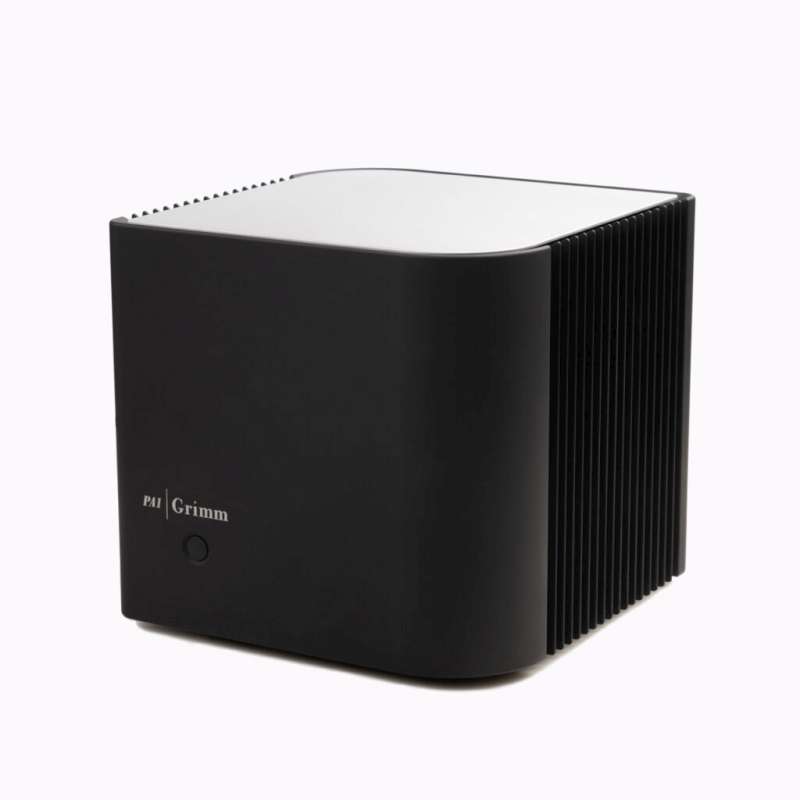
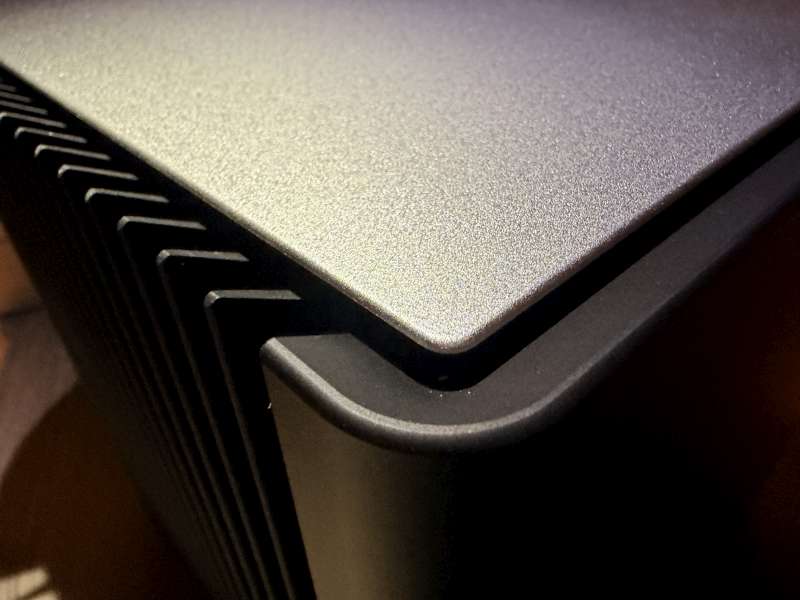
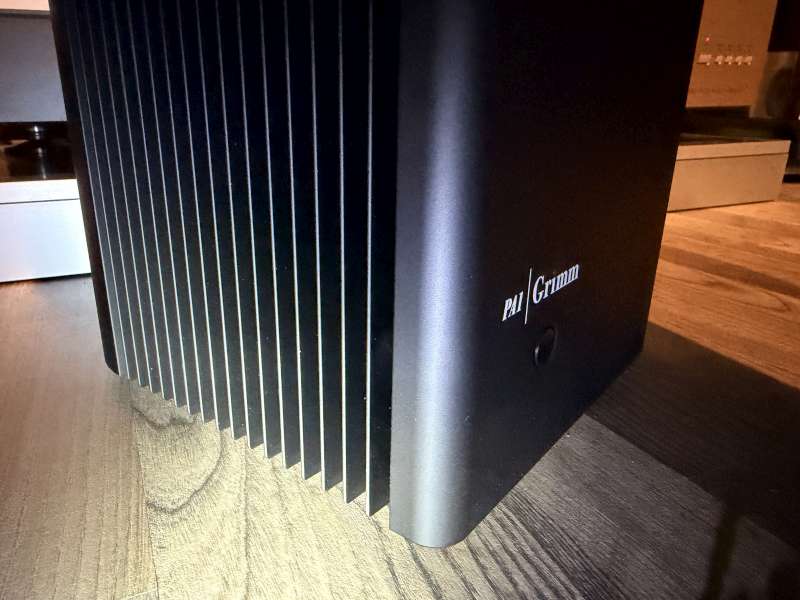
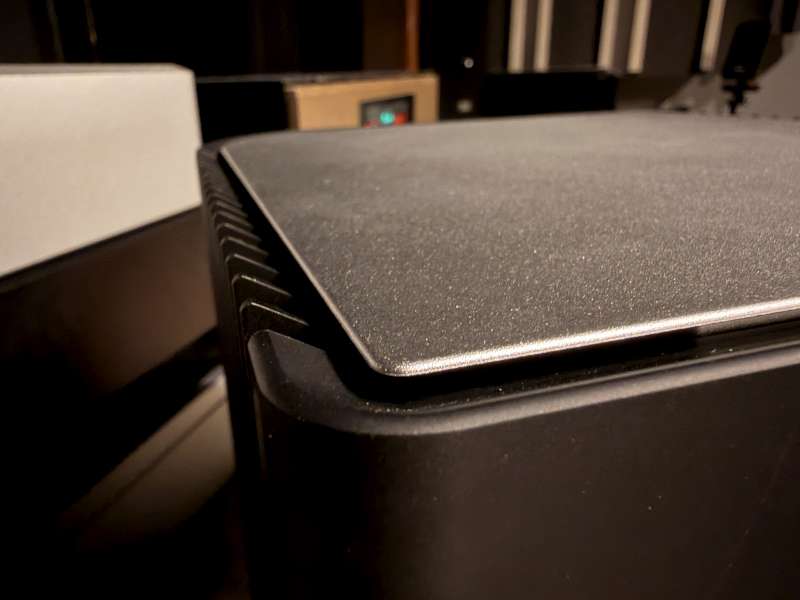
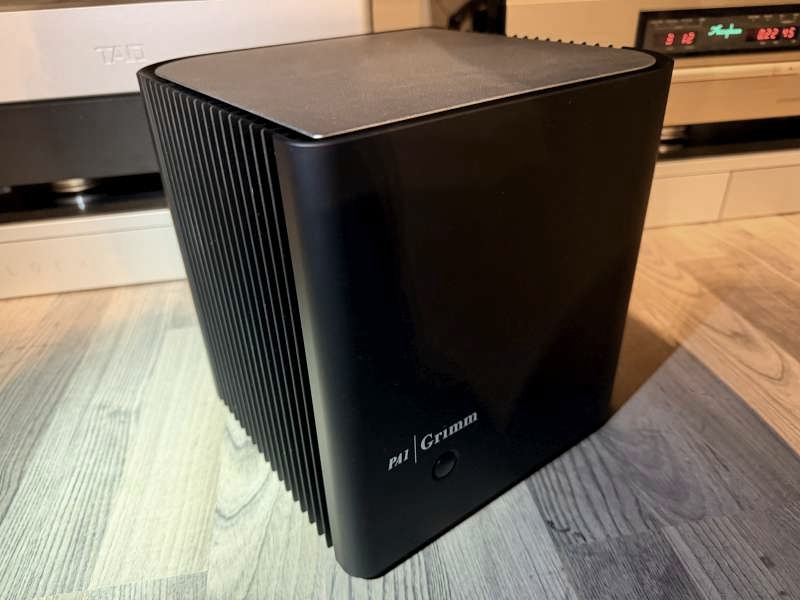
Externally, the PA1 is deceptively simple: clean-lined, elegant and unobtrusive. There are no visual theatrics here, just a neat, functional design that reflects the engineering within.
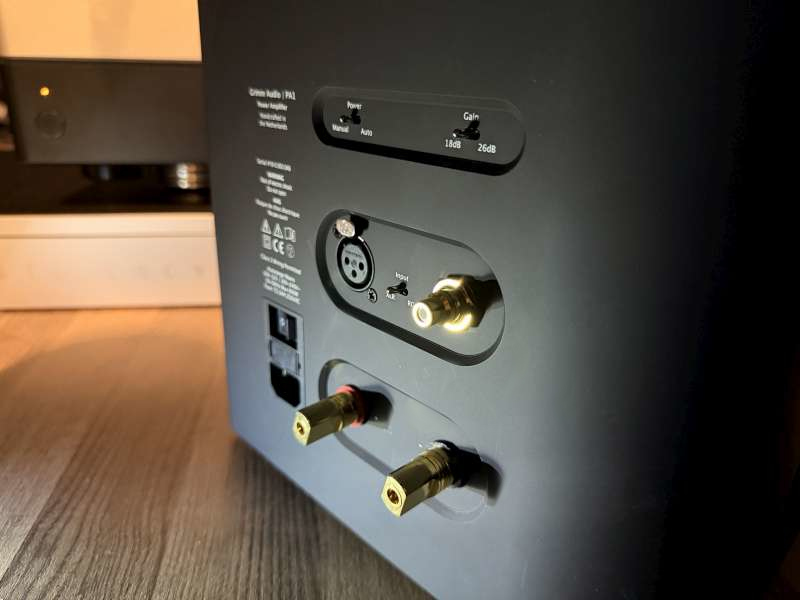
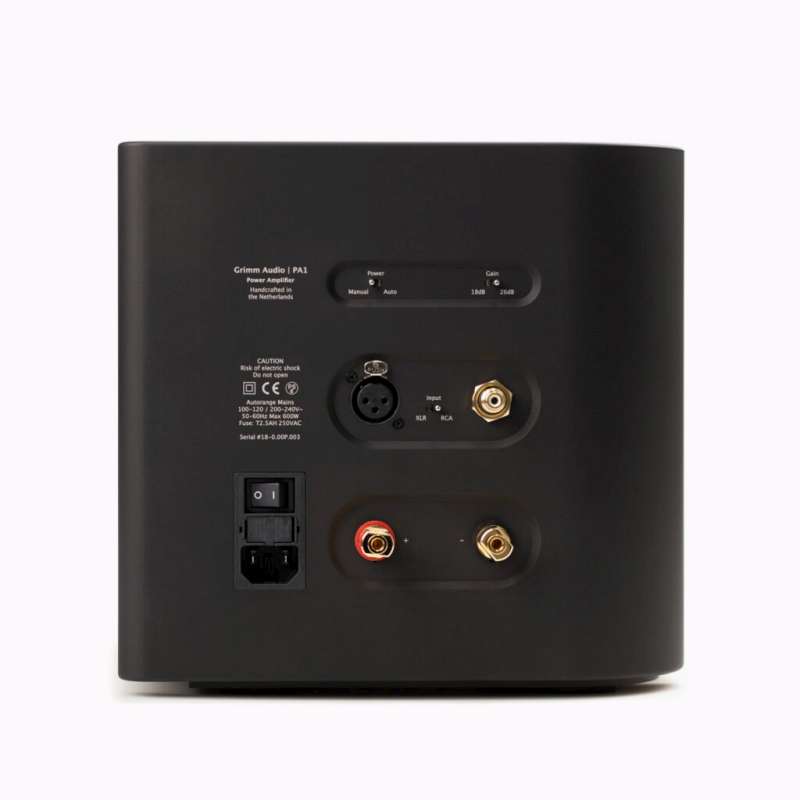
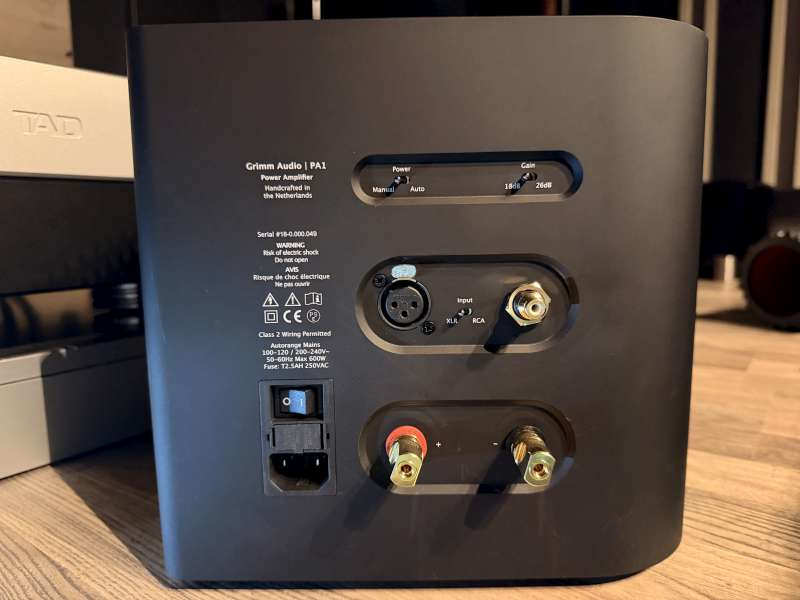
The rear panel provides selectable balanced XLR and unbalanced RCA inputs, together with a voltage gain toggle switch offering 18 and 26dB settings. Another small toggle switch offers an optional automatic power on/off function that switches the amplifier to standby after 40 minutes without a signal. The speaker binding posts are all metal (gold plated) with a flat nut that is easy to tighten. Each monoblock cube measures 250 × 250 × 240 mm which is super-friendly and I already picture a very nice bi-amping set-up. The provided feet are simple soft pads, and you’ll have to remove them if something more substantial (like Stillpoints) should be placed under the chassis; the footprint is too small to allow for a proper placement of aftermarket feet if you keep the pads there.
Bass management
I spent 10 days with a pair of PA1s and let me start by saying that this amp is one of the best machines I have ever auditioned - Sinner, from Eric Bibb’s Deeper in The Well, offers a revealing glimpse of what the Grimm PA1 power amplifiers can do. The album was recorded directly to a Korg MR2000S in pure 1-bit DSD, with EMM Labs DACs among the equipment used for mixing, and through the Grimms the immediacy of the live-in-studio recording was easy to appreciate. The harmonica on the right of the soundstage was a particular highlight: vividly present, precisely located, and alive with finely shaded dynamics. Rather than merely making the instrument stand out, the PA1s let its changing intensity give the performance expression and momentum. Even on day 1, out of the box and cold, the PA1’s precision and dynamic discrimination were remarkable. The only thing I wanted was a tad richer palette of tonal colours to complement that exceptional clarity.
That sense of colour arrived on day 4. I had left the Grimms powered up, playing mostly at low levels to allow the settle in my system, with two to three hours of casual listening each day. By then, the presentation had bloomed: the harmonica retained its incisiveness and expressive dynamic gradations, but its tone had become richer and its physical presence more convincing. The change brought to mind a soap bubble expanding into the room, its shimmering rainbow skin suggesting the additional hues now emerging from the music. Crucially, this greater tonal richness did not seem to come at the expense of the honesty and precision that had impressed me from the outset; the two qualities now worked together more persuasively. There was still a limit, however. When the PA1s replaced Audia Flight Strumento No.8 monoblocks in another system, they did not quite match the Class A tonal palette I heard from those amplifiers. That comparison put their character in perspective without diminishing the clarity, vitality, and finely graduated dynamics that made Sinner so compelling through the Grimms.
Clarity & delicacy
Compared with the Strumento No.8, Dissapear (Beyoncé, I Am... Sasha Fierce) sounded as clean as freshly washed linen, as though the sonic spectrum were suffused with the blueish morning colours of a new day. The bass was audibly better defined and tighter; the PA1s really do excel at impulses and transients. Low notes leave no trailing tail: they are forceful, linger not a millisecond longer than necessary, and are gone. Grimm’s clear advantage in the bass was also evident on Tom Sawyer, the opening track on Rush’s Moving Pictures. The kick drum really kicks, sending a pulse of air through your body and right to your spine, where it gives you a shiver.
The same track reveals another PA1 strength: impeccable separation. Each instrumental part is precisely delineated, with nothing blurring into anything else. You can focus on any line—the bass playing after the 2’ mark, for instance—and practically write down the notes on a sheet of paper as you listen. The bass has a wonderfully growling character, great dynamics and superb definition, yet never competes with the guitars or keyboards. As a result, reverberant decays are easier to hear, whether natural or added through effects; the reverb on the drums at the beginning of Tom Sawyer is much clearer, as is that surrounding Cassandra Wilson’s voice and the double bass on the acoustic Tell Me You’ll Wait for Me. Here, the ambience enveloping the singer and instruments is genuinely ‘tangible’—if air is something you can touch. On the other hand, the voice is not quite as human as it is through the Strumento, lacking that physical warmth. In fact, this perfectly illustrates the difference between Class A and Class AB. With transients and at the bottom of the frequency range, the Grimm PA1 is distinctly firmer and more precise; when it comes to harmonic richness and saturation, the Audia gets my vote instead. Instruments with fast leading edges—drums, bass, piano and pizzicato strings—fare better through the PA1s, whereas the Strumento has the upper hand where tonal shading matters: violin, cello and voice.
Tonal accuracy
The Grimm Audio PA1s are dead quiet monoblocks. Even with the volume set high and an ear right up to the tweeter, virtually nothing can be heard from the connected loudspeakers. And both pairs of loudspeakers we used with the PA1s have above-average sensitivity ratings: 92 and 96dB. Interestingly, the quoted signal-to-noise ratios are 112dB for the TAD and 120dB for the Audia Flight. The PA1’s shown S/N ratio is only 96dB (at 1W into 8Ω). Yet it sounded the most dynamic of them all. The answer to the riddle can be found only in the PA1´s manual which says 118dB (150 W, 8 Ω). Nothwithstanding that then the S/N ratios then are much more comparable, the Grimm outperforms both mentioned amps in terms of subjective dynamics. I suspect this is the result of the designers’ efforts to address transient phase behaviour; an orchestra playing in unison certainly makes a better impression than an ensemble playing out of tune, doesn’t it?
While I am on the subject of technical specifications, Grimm Audio does not state anywhere whether the PA1 can drive impedances below 4 Ω. It can. The Silent Laboratories Equilibrium loudspeakers dip to a minimum around 1.6Ω in the bass region, and the PA1s had absolutely no trouble to drive their bass to perfection.
Earlier, I mentioned the tiny toggle switch used to select the amplifier’s gain. If your source component’s output allows it—and it probably will, since we tried both 4V and 2V source output voltage, which virtually any DAC or player can deliver these days—run the PA1s at the lower gain setting of 18dB. The sound is audibly more relaxed, more natural and more dynamic.
And one final piece of good news: the Grimm Audio PA1s sounded excellent without a preamplifier, connected directly to the source. That is less common than you might think. Manufacturers generally design their power amplifiers to partner with their own preamplifiers, and power amps often do not take particularly kindly to the latter’s absence. Here, it works perfectly without a preamp, and unless you really need to switch between several inputs, I wholeheartedly recommend this cleaner approach. The PA1s are so transparent that they will let you hear any additional complication in the signal path—and that is something you do not want.
Spatial resolution
Would it really be an audio review without Chris Jones? This time, though, I´d pass over No Sanctuary Here (Roadhouses & Automobiles) in favour of Don’t Need Your Religion—and the Grimms made it a compelling choice. The opening bass pulses were a highlight, delivered with the kind of control and authority that immediately draws you into what comes next. Just as impressive was the clarity of the instrumental interplay: guitar, dobro, Hammond organ, and electric bass remained effortlessly distinguishable, each with its own character and clearly defined place in the mix. The backing vocals were firmly anchored within the soundstage, their placement lending the presentation a convincing sense of resolution depth. It was once again a striking demonstration of the PA1s’ ability to combine bass authority with exceptional separation—and an utterly compelling listen.
It is not that difficult to build a cost-no-object amplification with stunning performance. Like, for example, the Pilium Master Divine Kratos (3600 tis) that we have reviewed earlier or Audia Flight Strumento No.8 (2200 tis) that was one of the amps that we benchmarked the Grimm Audio PA1s against. What is difficult though, is to have this type of top performance at much more affordable price and this is where the PA1 is totally next level. Add the compact design that does not take too much precious space and there it is: a pair of mono power amplifiers with an unbeatable price to performance ratio.
Recommended resellers
RP Audio, Ostrava, +420 737 366 831
Manufacturer's website: http://www.grimmaudio.com
Associated components
- Sources: Wadax Studio Player (streamer/DAC/disc player), Accuphase DP-720 SACD,
- Amplifiers: TAD M2500 power amplifier, Audia Flight Strumento No.8 Signature mono power amplifiers, Grimm Audio MU2 (streamer/DAC/preamplifier)
- Interconnects and speaker cables: Synergistic Research SRX XL signal and speaker cables, Shunyata Research Sigma X, Ansuz Signalz C2, Gryphon Vanta, Audioquest Dragon Zero | Bass bi-wire, AAI Estremo
- Loudspeakers: Silent Laboratories Equilibrium, TAD Revolution One, Sonus Faber Gravis I
- Power conditioning: Synergistic Research SRX XL, GMG Power X-Blocker Exclusive Edition, Synergistic PowerCell 12 SX, TweakGuru Horizonta + Diamond Sound + Stein Music Ground Cube SIlver Signature zemnící jednotky a kabely, Stromtank S-1000, Shunyata Research Denali, Gryphon Vanta, Entreq Olympus Hero
Gallery
ACCUPHASE A-300
For Accuphase, the A-300 monoblock amplifier is considered a jewel in the crown. Although it is not the most powerful amp in their line-up – the P-7500 is with its 2x300W in Class AB – it is certainly the most powerful Class A device ...
Recommended resellers
Perfect Sound Group, Praha, tel. +420 722 960 690
Nisel SK, Bratislava, tel. +421 905 203 078
ACCUPHASE A-65
The A-65 has a better bottom-end control and though it does not equal to the solidness of, let's say, Bryston or Plinius, the improvement has moved the new amp in the right direction. Overall, the Accuphase A-65 is more refined, ...
Recommended resellers
Nisel SK, Bratislava, tel. +421 905 203 078
ACCUPHASE A-80
Before any critical listening, let the amplifier warm up for an hour, as it does not do its best when cold. When I owned A-70, I never switched it off, although I acknowledge it was quite an expensive for the Class A drew over 200 ...
Recommended resellers
Perfect Sound Group, Praha, tel. +420 722 960 690
Nisel SK, Bratislava, tel. +421 905 203 078
APOLLON AUDIO PET 950
Eigentakt is the current last word in Class D amplifier technology. It marries Class D efficiency and clean output power, low impedance rating, and compact design to vanishingly low harmonic and intermodulation distortion, and ...
Recommended resellers
Apollon Audio direct webshop
ASR Emitter II Exclusive Blue
When mankind is eliminated by a gigantic volcano eruption, a tsunami or Godzilla, most parts of the Emitter will remain to exist as this amplifier is dustproof, waterproof and heatproof. The ASR's catalogue is far from complicated - ...
Recommended resellers
Audiostudio s.r.o., Olomouc, tel. +420 608 752 475
AUDIA FLIGHT Strumento No.8 Signature
Throughout Audiodrom’s history, there are two power amplifiers that top the list of the most-tested amplifiers ever. These are my own TAD M2500, which never made it into a proper written review, and the Audia Flight Strumento models, ...
Recommended resellers
TYKON, Ostrava, tel. +420 723 449 894
AUDIO RESEARCH Reference 80S
Audio Research is an amplifier legend. The brand had been expected to get a boost when it was acquired by Fine Sounds Group (now transformed into McIntosh Group), however, the lift off did not happen. Recently the brand has been ...
Recommended resellers
HI-FI studio TYKON, Ostrava, tel. +420 723 449 894