LUXMAN B-100 Centennial
Power amplifiers
Centennial means happening once in 100 years of Luxman’s history. What other brand in the high-end audio market can boast such a long tradition? Paradoxically, when you see Luxman models lined up side by side—from the historic ones to the current ones—you can still tell immediately that they’re Luxman. The company has consistently used the same, unmistakable design language, and yet every single product felt both contemporary and modern in its own time. Some models, however, are utterly timeless—take, for example, the DA-07 DAC from the late 1980s, or the M-08 power amplifiers from the 1990s. These would still draw a flurry of camera shutters at any audio show today. After all, Luxman has always excelled at power amplifiers, so I couldn’t pass up the new flagship B-100 Centennial monoblocks, which represent the culmination of the brand’s expertise to date.
Function and form
The B-100 Centennial operates in pure Class A mode up to 25 watts into 8 ohms. When more output is required, it transitions into Class AB operation and delivers a continuous 125 watts into 8 ohms or 250 watts into 4 ohms. Luxman also specifies peak output of up to 1,000 watts into a 1-ohm load. Previously, Luxman used bridged BTL configuration in their monaural power amplifiers. However, the BTL results in higher output impedance and for the new model, they wanted to prioritize excellent driveability and linearity. This allows the B-100 Centennial to maintain excellent linearity and deliver high current even into extremely low-impedance loads.
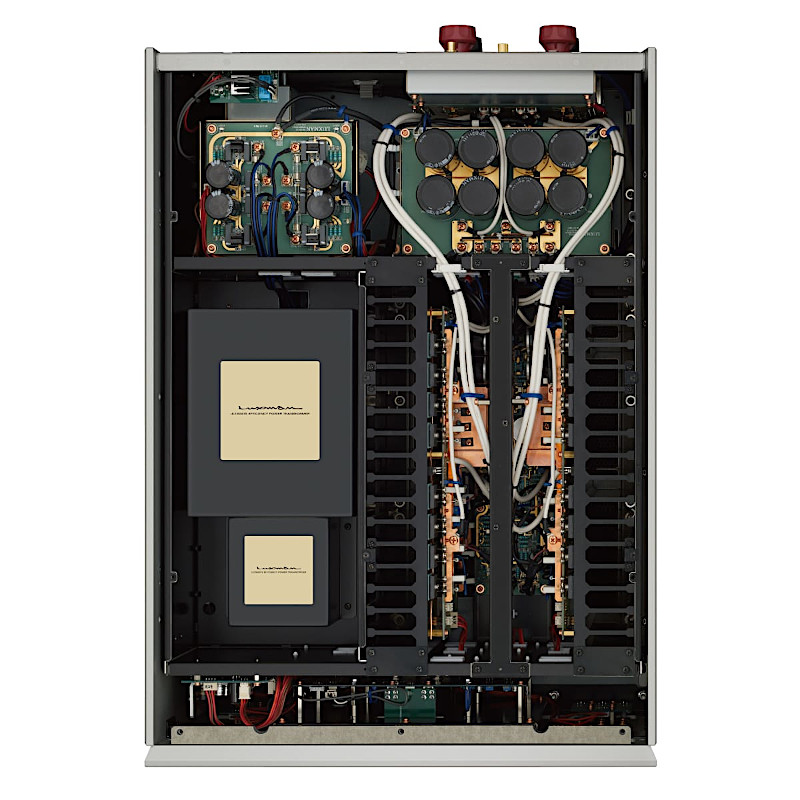
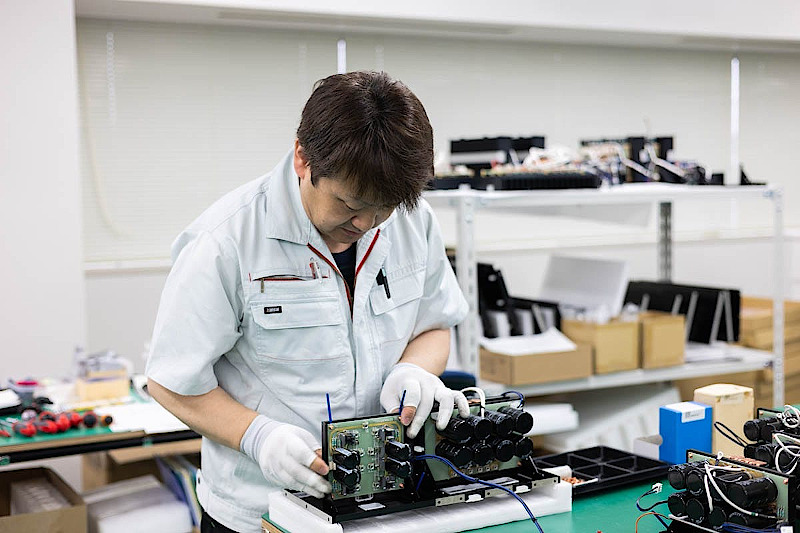
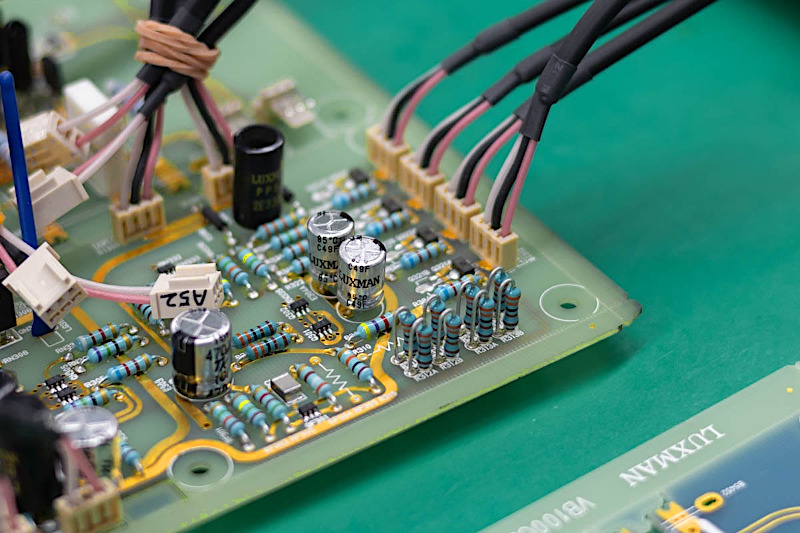
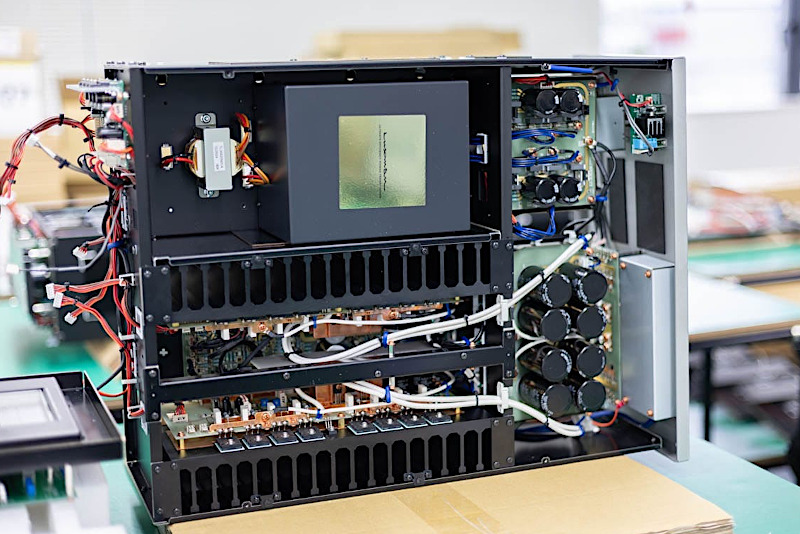
Internally, the B-100 Centennial uses 2700 parts in a fully balanced circuit layout. Its newly developed output stage incorporates four parallel amplifier modules for each half of the signal. A large 1,250VA EI-core transformer forms the foundation of the B-100 Centennial’s power supply. The scale of the power supply contributes to the amplifier’s considerable physical weight of around 60 kg. To support the mass, Luxman has developed the mechanical construction to reduce vibration and unwanted interaction between the chassis and audio circuitry. A multilayer base plate adds structural support, while solid cast-iron feet are used to control mechanical vibration. These measures are intended to limit microphonic effects that could affect the amplifier’s sensitive circuitry.
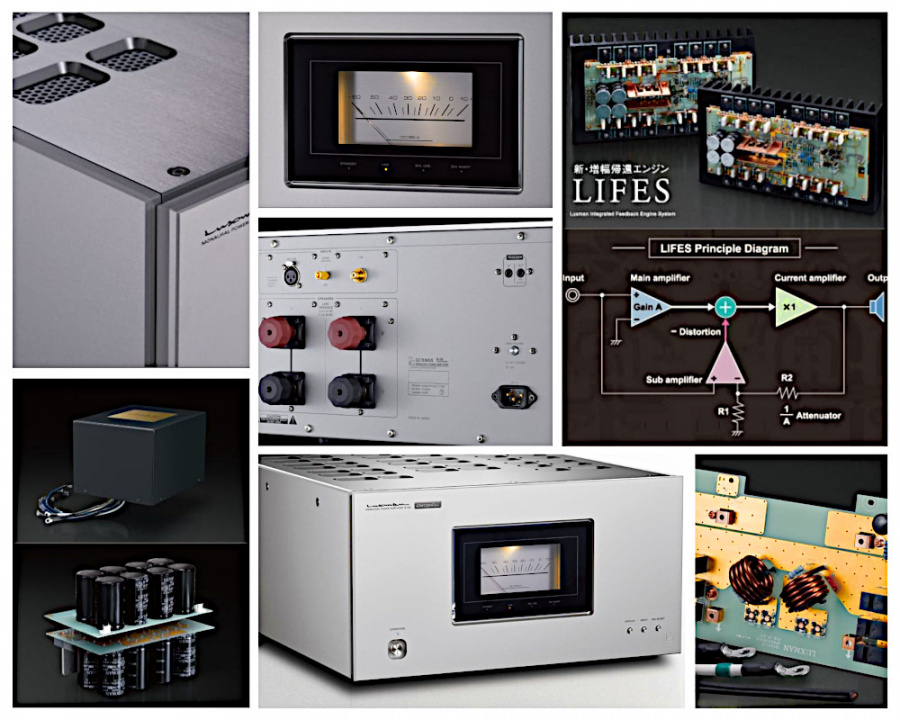
With the 100th anniversary, Luxman has revamped his ODNF (Only Distortion Negative Feedback) to what they now call LIFES circuit. The name stands for Luxman Integrated Feedback Engine System, and this new 1.1 version forms part of the company’s approach to distortion control. Rather than applying conventional overall negative feedback throughout the circuit, LIFES 1.1 is designed to intervene specifically where distortion occurs. Luxman says this method is intended to preserve dynamics, timing behavior and low-level tonal information while maintaining signal accuracy.
Also, the B-100 Centennial uses what the company calls a “loopless chassis”. Currents running through a standard metal chassis can create ground loops and small fluctuations in ground potential. The loopless structure keeps the ground reference point completely stable. By optimizing the internal grounding, the noise floor is said to be lowered, and it allows micro-details in the music to emerge cleaner than before.
Bass management
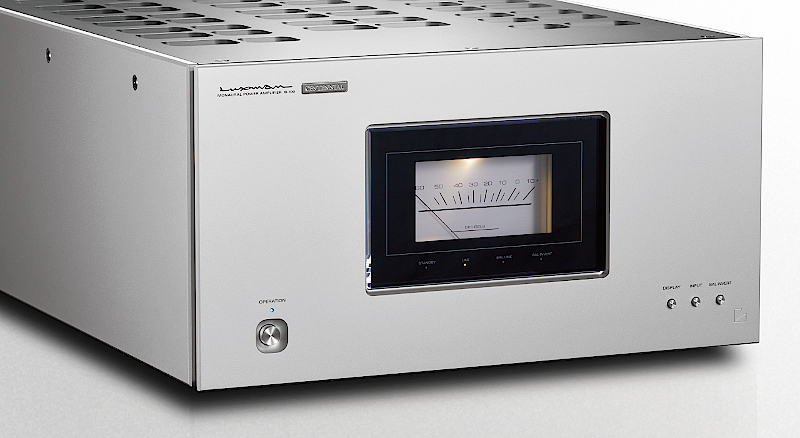
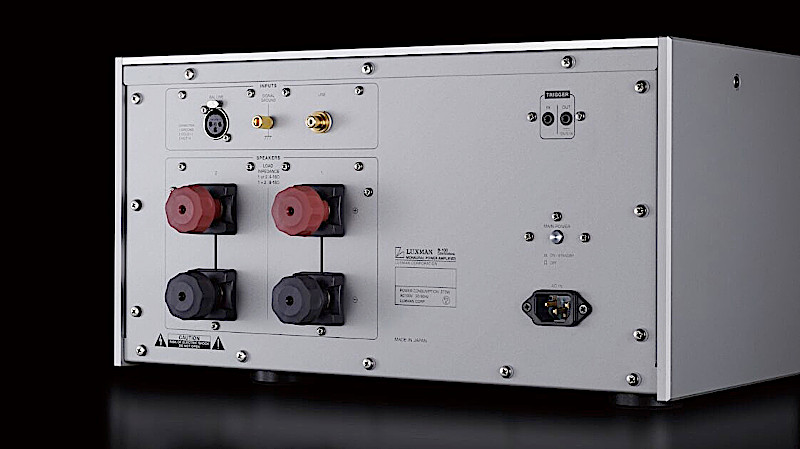
From outside, Luxman has set on a quest to make their high-end devices look like pieces of silver jewellery. It is a pity that the pictures cannot do the justice to how beautiful and clean the B-100 Centennial looks in reality; the impeccable silver finish, the hairline manufacturing precision, the refinement of the front panel, and even the fine print on the chassis, all scream top quality. Around the back, there are two sets of speaker terminals, a grounding post, a mains button, balanced and single-ended inputs, and a system trigger. The front panel allows toggling between the inputs, changing the balanced input polarity, and switching the display on and off. The mains button on the front panel sends the unit into a stand-by mode.
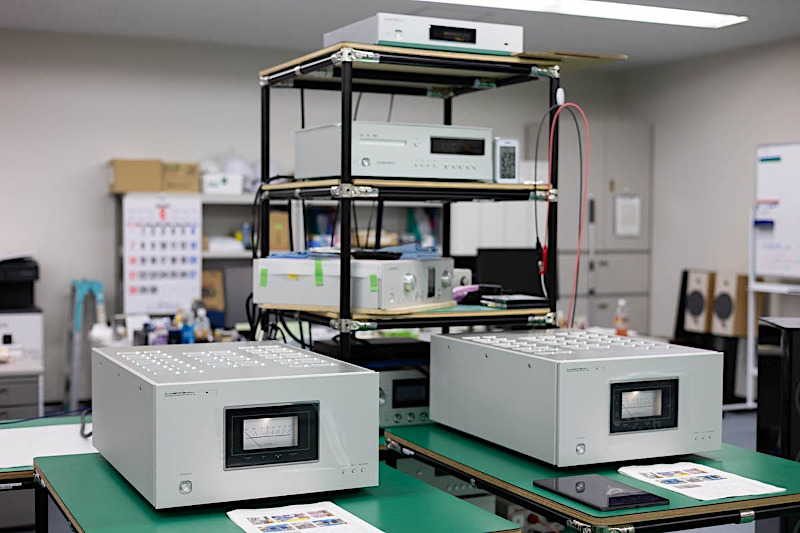
To provide some context for what follows. Representatives from Luxman, including the director of R&D, gave me a nearly private listening session early in the morning at the Vienna exhibition, before the first crowds arrived. I spent about two hours with a well burnt-in high-end system, which would be very difficult to organize under local conditions. I would like to take this opportunity to thank Luxman for making this possible.
Clarity & delicacy
I assume that no one considering this brand expects to get clinical-sounding result. But if you expect the typical Japanese politeness of a bygone era, you won’t find it here either. And while there was a certain degree of forgiveness when the speakers were driven by the new L-100 Centennial integrated amp, it all disappeared when we switched to the B-100. The authority and solidity that come with the anniversary monoaural amplifiers are evident immediately, and the sound is incredibly precise and tight.
To start with, the Luxman B-100 handles sibilants very nicely. They’re firm, sound, and expressive, but never etched or over the top. This is by no means easy to achieve if you want the sound to feel open and detailed yet not fatiguing. Luxman has always treated high frequencies with velvet gloves, emphasizing a non-aggressive sound, but this was also something that seemed to hold the music back a bit—it used to be almost too non-aggressive. The Centennial model isn’t as ‘muted’ in this regard, and the greater immediacy and connection with the listener suit it wonderfully. This is evident not only in how flawlessly it handles any vocals and especially the female ones, but also with the piano, where the hammers take on more edge and the character of the felt striking the strings is significantly more percussive than it has ever been before. Nevertheless, a certain level of comfort and warmth of the B-100 Centennial is still detectable, especially in the lower frequencies.
Tonal accuracy
The bass and kick drum have never been—and still aren’t—a muscular display à la D’Agostino through the Luxman, nor do they have the tight grip of CH Precision or TAD. Its bass is rounder and more voluminous in the sense of the space it fills, but still tight, controlled and without any frequency emphasis. Actually, it is very well integrated with the rest—there’s neither too much nor too little of it. It’s more about its character. In one of my favorite tracks, The Trouble You’re In (Fink, Elac Anniversary sampler), the opening guitar shot out of the speakers with very decent dynamics and a beautiful aura around the strings and the voice. Back in the day, this is exactly how Luxman promoted its amplifiers: “We’re not just after a fast response, but the reconstruction of a sound that touches us deep in the heart and which, as it lingers, creates the illusion of reality.” They clearly still adhere to this philosophy, and the monoblocks deliver clean, long decays with a beautiful sense of calmness in the background, allowing the sound to fully unfold harmonically and resonate in the room. As mentioned, the dynamic explosiveness won’t knock you off your feet, but it’s powerful enough that, with the right recordings, you’ll get a taste of live and uncompressed concert sound. And that’s enough to make the performance unfold in front of you with believable realism.
When playing at a relatively high volume in a spacious room (~100 m²), each of the monoblocks drew about 7 VA from its Stromtank, or approximately 200 W. Since the Marten Parker Quintet are specified as 4-ohm speakers with an above-average sensitivity of 93 dB, they were a truly excellent choice to pair with both Luxman mono amplifiers under these conditions. With less sensitive speakers, we would have reached the power limit. On the other hand, most of us won’t have the luxury of listening at home in such a large space, will we?
Spatial resolution
All in all, listening to music through the Luxman B-100 Centennial monoblocks is an experience for connoisseurs. It’s a wonderfully effortless, and above all, a completely natural experience. You don’t get the feeling that it’s trying to force the music on you, and it doesn’t actively editorialize it either, as tube amplifiers often do. As far as the B-100’s spatial capabilities are concerned—even under less-than-optimal conditions - the soundstage was deep, wide, and well-defined. Coming back to the vocals, the singers were not too forward and right in my face, nor were they pushed back into some sort of false illusion of depth. The layering of the soundstage was, once again, very natural, and this allowed me to truly relax while listening, as there were no obvious imperfections to distract my ears from enjoying the music.
It’s a pity that, under the given circumstances, it wasn’t possible to swap out the cables being used. I understand that the brand positions itself as capable of delivering a complete system—and in practice, it succeeds, because the resulting sound is truly excellent—but if I owned the Luxman Centennial system, the interconnect, power, and speaker cables would be the first thing I’d focus on. It’s more than likely that I haven’t yet heard the absolute best these mono amplifiers have to offer.
At a price of around 50k€ per pair, the Luxman B-100 Centennial monos are not for everyone. But I wish they were. It’s a superbly crafted audio component, built on the experience and skill of people who know exactly what they’re doing and who have a perfect sense of sonic aesthetics. It’s one of those few products that, if I had the space, I’d love to have at home.
Recommended resellers
HTP s.r.o., tel: +420 606 642 175
PP HiFi Otrokovice, tel. +420 603 581 305
Nisel SK, Bratislava, tel. +421 905 203 078
Manufacturer's website: http://www.luxman.co.jp
Associated components
- Sources: Luxman D-100 Centennial SACD player
- Loudspeakers: Marten Parker Quintet Diamond Edition
- Amplifiers: Luxman C-10x preamplifier, Luxman B-100 Centennial monoaural amplifiers , Luxman L-100 Centennial integrated amplifier
- Interconnects and speaker cables: Luxman JPC-15000 and Luxman JPS-15000
- Power conditioning: 2 x Stromtank S-2500 Quantum MKII
Gallery

ACCUPHASE A-300
For Accuphase, the A-300 monoblock amplifier is considered a jewel in the crown. Although it is not the most powerful amp in their line-up – the P-7500 is with its 2x300W in Class AB – it is certainly the most powerful Class A device ...
Recommended resellers
Perfect Sound Group, Praha, tel. +420 722 960 690
Nisel SK, Bratislava, tel. +421 905 203 078
ACCUPHASE A-65
The A-65 has a better bottom-end control and though it does not equal to the solidness of, let's say, Bryston or Plinius, the improvement has moved the new amp in the right direction. Overall, the Accuphase A-65 is more refined, ...
Recommended resellers
Nisel SK, Bratislava, tel. +421 905 203 078
ACCUPHASE A-80
Before any critical listening, let the amplifier warm up for an hour, as it does not do its best when cold. When I owned A-70, I never switched it off, although I acknowledge it was quite an expensive for the Class A drew over 200 ...
Recommended resellers
Perfect Sound Group, Praha, tel. +420 722 960 690
Nisel SK, Bratislava, tel. +421 905 203 078
APOLLON AUDIO PET 950
Eigentakt is the current last word in Class D amplifier technology. It marries Class D efficiency and clean output power, low impedance rating, and compact design to vanishingly low harmonic and intermodulation distortion, and ...
Recommended resellers
Apollon Audio direct webshop
ASR Emitter II Exclusive Blue
When mankind is eliminated by a gigantic volcano eruption, a tsunami or Godzilla, most parts of the Emitter will remain to exist as this amplifier is dustproof, waterproof and heatproof. The ASR's catalogue is far from complicated - ...
Recommended resellers
Audiostudio s.r.o., Olomouc, tel. +420 608 752 475
AUDIA FLIGHT Strumento No.8 Signature
Throughout Audiodrom’s history, there are two power amplifiers that top the list of the most-tested amplifiers ever. These are my own TAD M2500, which never made it into a proper written review, and the Audia Flight Strumento models, ...
Recommended resellers
TYKON, Ostrava, tel. +420 723 449 894
AUDIO RESEARCH Reference 80S
Audio Research is an amplifier legend. The brand had been expected to get a boost when it was acquired by Fine Sounds Group (now transformed into McIntosh Group), however, the lift off did not happen. Recently the brand has been ...
Recommended resellers
HI-FI studio TYKON, Ostrava, tel. +420 723 449 894