MOLA MOLA Ossetra
Power amplifiers
Imagine that in your thirties, forties, or fifties, after you think you know the world around you, a specialist comes to see you and says, “I think we can now remove those grey-tinted filters from your eyes.” And suddenly you see, for the first time in your life, the world with a level of contrast unlike anything before. After spending hours with the Ossetra monoblocks, I can say that going back to anything else is, in this respect, rather difficult.
Function and form
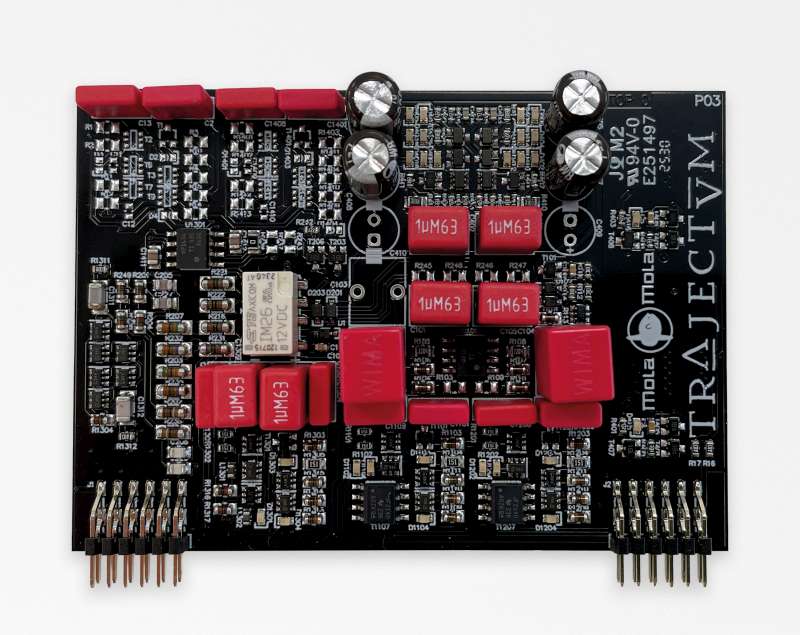
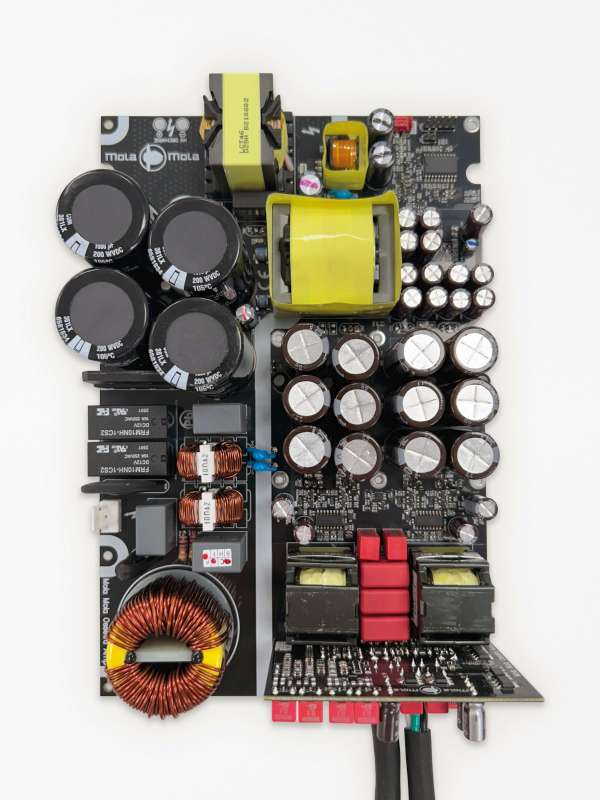
The Ossetra is Mola Mola’s current flagship mono power amplifier, based on the company's new proprietary Trajectum amplification architecture rather than the earlier Ncore-derived designs they used in the Kaluga, the Ossetra’s predecessor. It is a fully balanced Class D amplifier incorporating newly developed discrete Class A input and gain stages. A key design objective was improving linearity through a combination of a redesigned power supply, wide-bandwidth analogue stages, and an unusually high-feedback topology (the amplifier employs over 80dB of global feedback). According to Mola Mola, this allowed major reductions in noise, distortion, and load dependency. The power stage uses MOSFET output devices switching at approximately 550kHz, while the amplifier remains fully differential from input to speaker terminals. The Ossetra monos, with their small footprint, offer power output of 350W into 8Ω, 700W into 4Ω, and 900W into 2Ω, with current capability reaching approximately 31A, enabling operation with very low-impedance and reactive loudspeaker loads, a damping factor >5000. They are a testament to how far the current “digital” amplifiers can go.
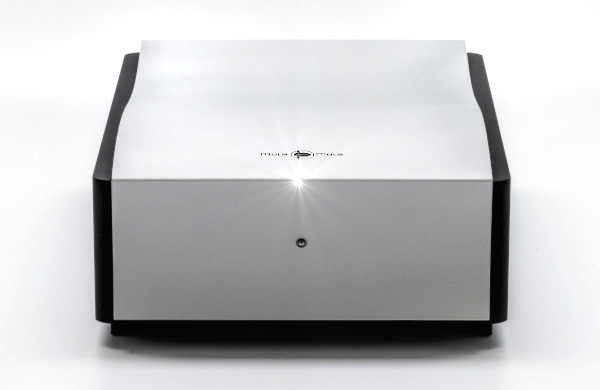
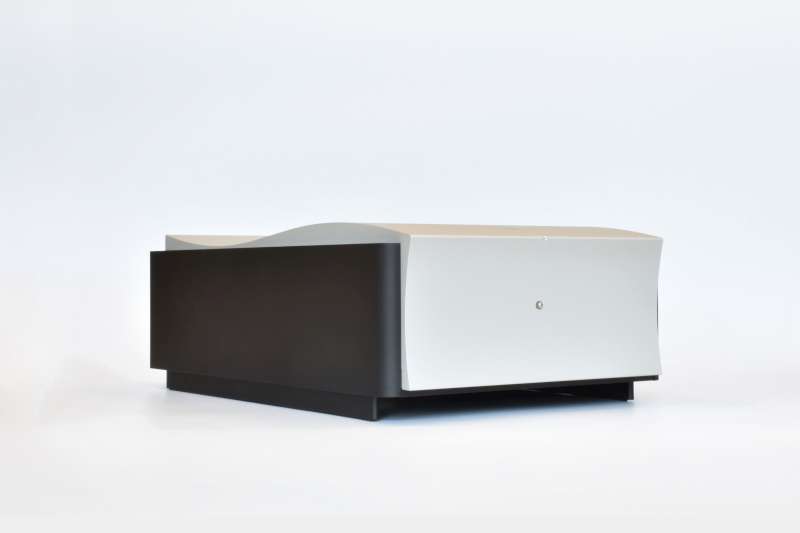
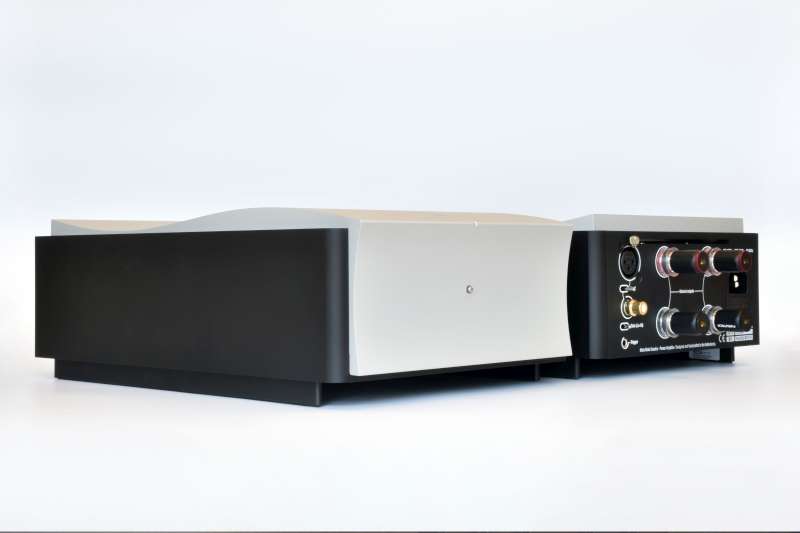
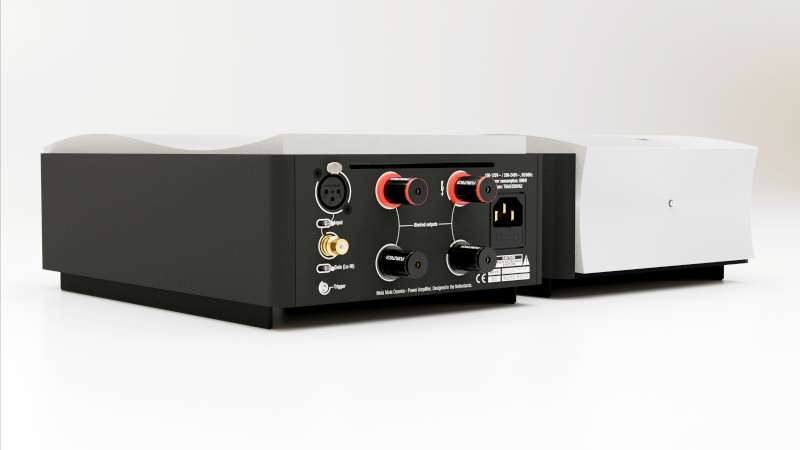
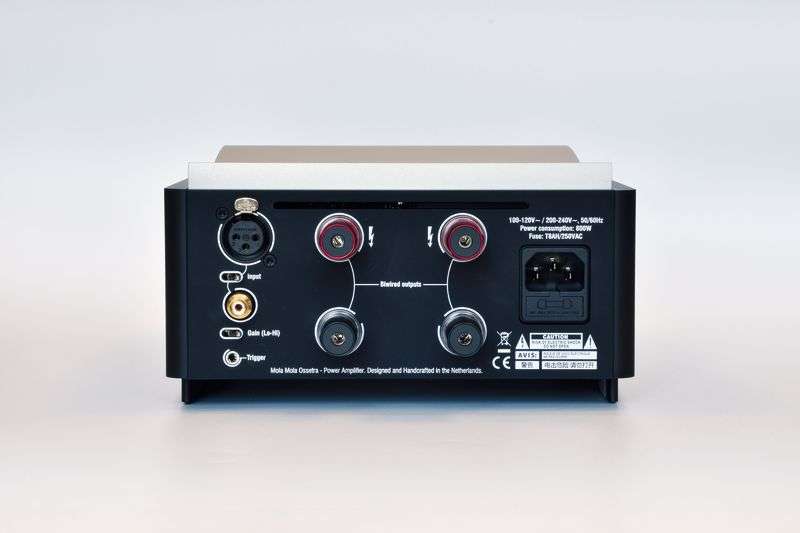
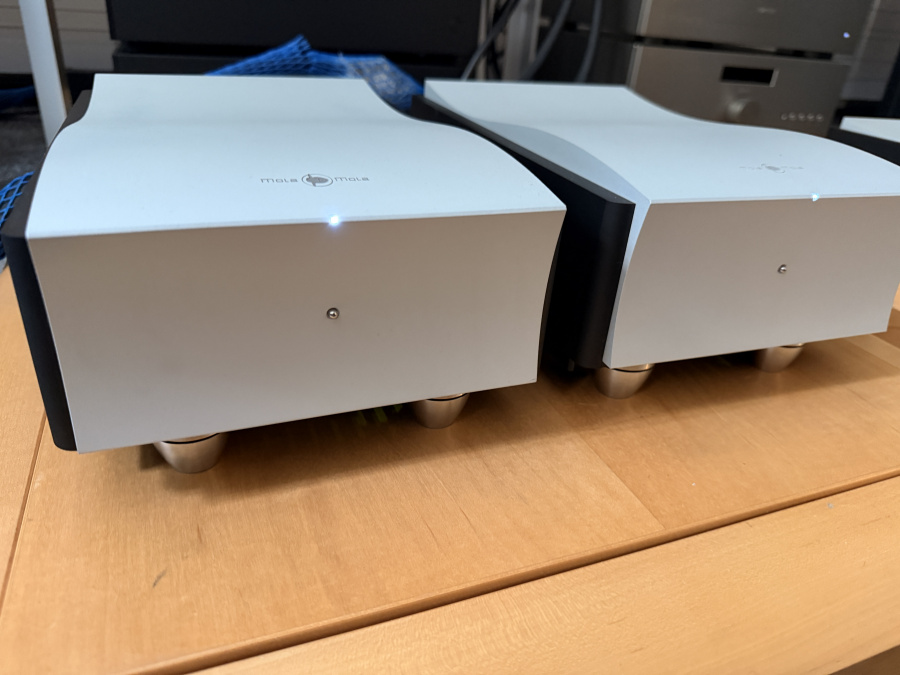
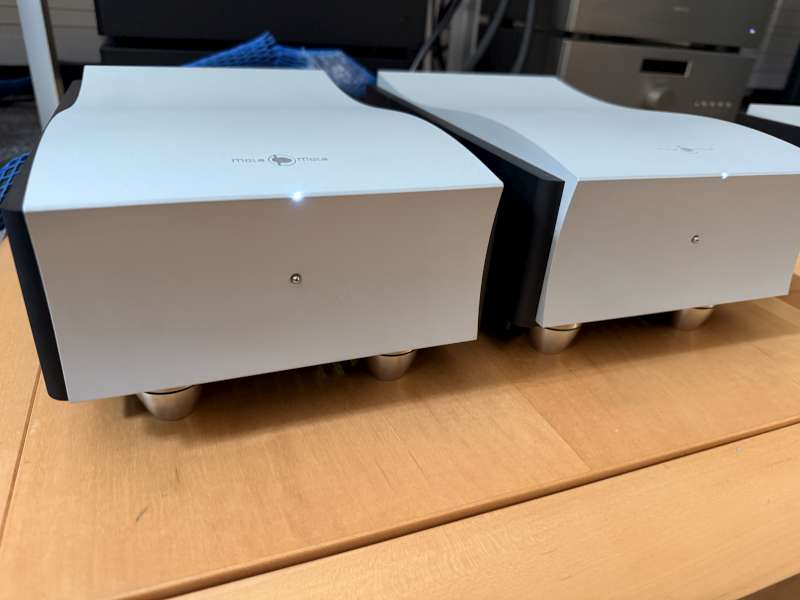
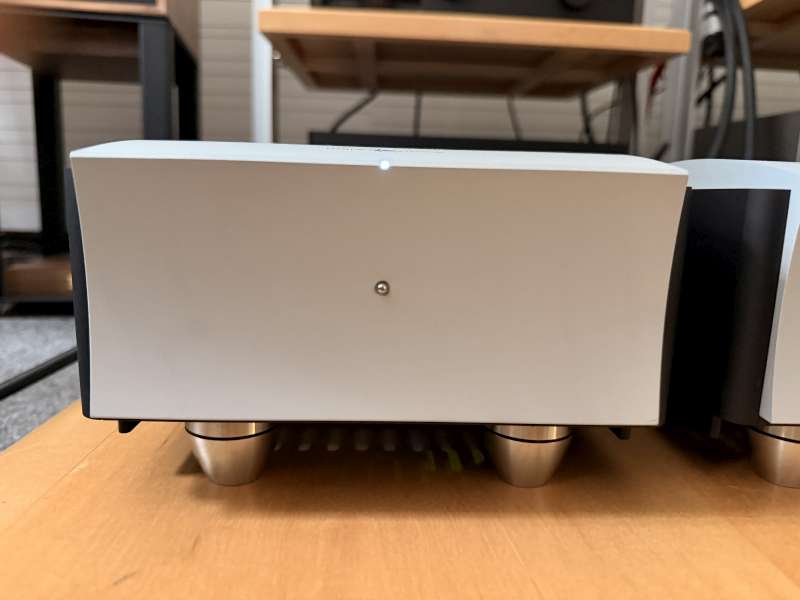
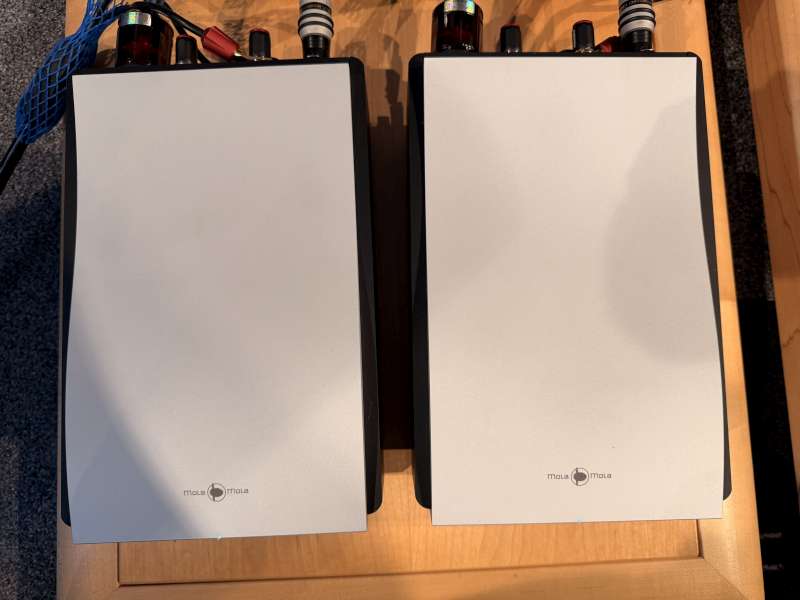
Physically, each monoblock uses Mola Mola's compact half-width aluminum chassis measuring 200 × 110 × 335mm and weighing about 7kg. While I really love the compact chassis, it comes with penalty in terms of heat dissipation, as you’ll read further. Connectivity includes balanced XLR and unbalanced RCA inputs (switch selectable), a gain switch (22dB or 28dB), trigger input, and two pairs of Furutech speaker terminals.
Bass management
So let us start with the aforementioned contrast. Mola Mola specifies a signal-to-noise ratio of 130dB, while the input section reaches an astonishing 150 dB, right at the very edge of measurable distortion (0.000003%). Add to that—according to the manufacturer—a perfectly flat frequency response with the upper limit somewhere around 100 kHz. Another10–20 decibels difference versus the best high-end amplifiers should not be that dramatic, you think, since we are talking about low-level signals (Editor’s note: At least versus those manufacturers that actually state signal-to-noise figures, because many—presumably out of modesty—do prefer not to include them in their specifications.). The opposite is true, however: you can hear the boost in the S/N value, and very clearly. With the Ossetra, listening feels like opening a window into a hall full of musicians—not only as if nothing at all stands between your ears and the music, but as if someone has also run the room’s air through a purifier that removes even the tiniest dust fibres and set the temperature to an ideal 21°C. The cleanliness and dynamic contrast of the Ossetra monoblocks are of such an order that everything else sounds contaminated. Their predecessors, the Mola Mola Kaluga monoblocks, behaved similarly, but here the overall transparent purity is noticeably better, and the new amplifier provides plenty of study material for discovering how each recording was made.
Clarity & delicacy
I will divide this review into two parts. In the first, the Ossetra monoblocks were driven by the analogue preamplifier built into the Grimm Audio MU2 all-in-one unit. I will return to the MU2 in a separate review, because it is an outstanding source component in its own right. In tandem with the Mola Mola, both devices worked absolutely superbly as demonstrated, for example, by the drums in Sierra Highway (Pat Coil), which had the potential to knock the listener out of the chair. Or the electric blues piece Come to Find (Doug McLeod), which I could play as loudly as I wanted while still receiving an incredibly dynamic, clean, and controlled sound with almost obsessively precise contours and spatial layout. The plucked strings are rendered as if on a drawing board, and the contrast between silence and sound is fabulous. The bass in Ayers Rock (Charly Antolini) also sends seismic waves through the room, although with Mola Mola you rather expect such unmatched definition at the bottom end. What really caught my attention, however, was how the amplifier handlied various tambourines, jingles, cymbals, resonating sheets of metal, and other generators of higher frequencies; this is where Mola Mola has done the homework, pushing the Ossetra’s top end much further with the new Trajectum platform than the previous Kaluga monoblocks managed. The cymbals no longer sound digital here and, in their delicacy, resemble Class A amplifiers more closely.
Tonal accuracy
The comparison with Class A is not entirely out of place, because the Ossetra has a Class A driver section; you will discover that the manufacturer is not exaggerating after just half an hour, when the monoblock chassis become properly hot. Very hot, in fact. I understand that the designers wanted to preserve the unusual format and wavy chassis silhouette, but the components inside would certainly benefit from heatsinks or some kind of ventilation slots.
Returning to the treble and the presence region of the frequency spectrum, I perceived, for example, my favourite Away Down The River (Alison Krauss) a little differently through the Mola Mola than I do at home. Where, with my TAD, I hear a controlled thickness in the mid-bass that pulls the singer’s vocal forward and lights up the guitar solo in the upper mids, the result with the Ossetra monoblocks is more “studio-like”. Nothing and no one are favoured here, so Alison does not reach out to me quite as much, but in return I have a perfect overview of who is standing or sitting and where, how they move, and how voices and instruments interact with the space in which the music was recorded. Blue Spanish Sky (Chris Isaak) once again confirmed the unbelievable intelligibility of everything happening at the lower end of the spectrum. The control of the bass guitar is admirable, and although it is not meant to be a centrepiece of the track—this is reserved for Isaak’s Elvis-like baritone—it is the very bass guitar that forms the backbone of the track. Everything happens with absolute precision and ease: no electrical haze, no noise added to the recorded material.
This brings me to the second part of the review. Mola Mola naturally developed the Ossetra monoblocks to pair with their Kula preamplifier, which can also be fitted with the Tambaqui DAC module, which I have reviewed earlier. Logic therefore suggests— and also some published reviews support it —that only with the Kula these mono amplifiers truly blossom and fly in their full glory. So, I liberated the Grimm Audio MU2 from its preamp duties and let the Kula do the work instead, with the MU2 serving only as a streamer. To keep it short: of the two, I would still choose the MU2 as a preamp. With it, you get a firmer sound, more precise transients, and better-defined edges and contours. With the Kula, it is as if someone has hung a very light veil between you and the musicians - and that is not what you want. It is possible, and likely, that another pair of XLR interconnects and a power cable and an additional piece of gear in the signal path are the reason for that, compared to less complicated MU2. I tried to experiment with the signal cables, and it is true that moving from copper wires with Furutech CF-602F plugs to the silver-gold wires of Gryphon Vanta interconnects reduced this veil, but not all of it. If you decide on Mola Mola, it makes sense to have the Kula preamplifier and Tambaqui in the chain as well, anyway. That is perfectly fine, but in that case, you certainly will not avoid searching for the best-matching interconnect and power cable. It would be a shame to underestimate this part and fail to get the most of the Ossetra monos.
Spatial resolution
The question is whether today’s listener is ready for such perfection. While listening to the Ossetra, I found myself in a kind of schizophrenia, where a certain degree of imperfection may be missed—especially when part of the attractiveness of your home sound probably comes from slightly incomplete bass, nice but rounded transients, deceptive phase shifts, or simply a considerable amount of harmonic distortion (present with tubes, tapes, and vinyl). The problem, however, is that after experiencing the Ossetra, most other amplifiers sound cloudy. You are therefore inevitably faced with a difficult choice because listening habits are hard to change. It is a bit like putting on completely new clothes. Usually, you do not feel comfortable in them until they loosen up a little. On the other hand, you do not want to go back to wearing dirty ones, do you?
Recommended resellers
RP Audio, Ostrava, +420 737 366 831
Manufacturer's website: http://www.mola-mola.nl
Associated components
- Sources: Audionet ART G3 CD transport, Grimm Audio MU2 streamer/DAC/preamp
- Amplifiers: Mola Mola Ossetra, Gryphon Antileon Revelation stereo
- Interconnects and speaker cables: Gryphon Audio Vanta speaker, Audionet IC, Furutech bulk cable with Furutech Cf-602f plugs
- Power conditioning: Gryphon Audio Powerzone 3, Gryphon Audio Vanta
Gallery
ACCUPHASE A-300
For Accuphase, the A-300 monoblock amplifier is considered a jewel in the crown. Although it is not the most powerful amp in their line-up – the P-7500 is with its 2x300W in Class AB – it is certainly the most powerful Class A device ...
Recommended resellers
Perfect Sound Group, Praha, tel. +420 722 960 690
Nisel SK, Bratislava, tel. +421 905 203 078
ACCUPHASE A-65
The A-65 has a better bottom-end control and though it does not equal to the solidness of, let's say, Bryston or Plinius, the improvement has moved the new amp in the right direction. Overall, the Accuphase A-65 is more refined, ...
Recommended resellers
Nisel SK, Bratislava, tel. +421 905 203 078
ACCUPHASE A-80
Before any critical listening, let the amplifier warm up for an hour, as it does not do its best when cold. When I owned A-70, I never switched it off, although I acknowledge it was quite an expensive for the Class A drew over 200 ...
Recommended resellers
Perfect Sound Group, Praha, tel. +420 722 960 690
Nisel SK, Bratislava, tel. +421 905 203 078
APOLLON AUDIO PET 950
Eigentakt is the current last word in Class D amplifier technology. It marries Class D efficiency and clean output power, low impedance rating, and compact design to vanishingly low harmonic and intermodulation distortion, and ...
Recommended resellers
Apollon Audio direct webshop
ASR Emitter II Exclusive Blue
When mankind is eliminated by a gigantic volcano eruption, a tsunami or Godzilla, most parts of the Emitter will remain to exist as this amplifier is dustproof, waterproof and heatproof. The ASR's catalogue is far from complicated - ...
Recommended resellers
Audiostudio s.r.o., Olomouc, tel. +420 608 752 475
AUDIA FLIGHT Strumento No.8 Signature
Throughout Audiodrom’s history, there are two power amplifiers that top the list of the most-tested amplifiers ever. These are my own TAD M2500, which never made it into a proper written review, and the Audia Flight Strumento models, ...
Recommended resellers
TYKON, Ostrava, tel. +420 723 449 894
AUDIO RESEARCH Reference 80S
Audio Research is an amplifier legend. The brand had been expected to get a boost when it was acquired by Fine Sounds Group (now transformed into McIntosh Group), however, the lift off did not happen. Recently the brand has been ...
Recommended resellers
HI-FI studio TYKON, Ostrava, tel. +420 723 449 894