LEGACY AUDIO V System
Floorstanding loudspeakers
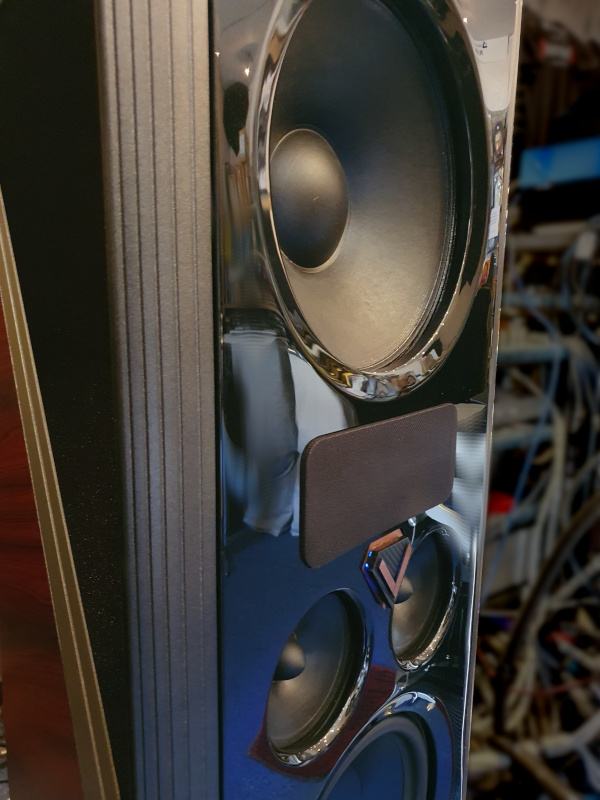
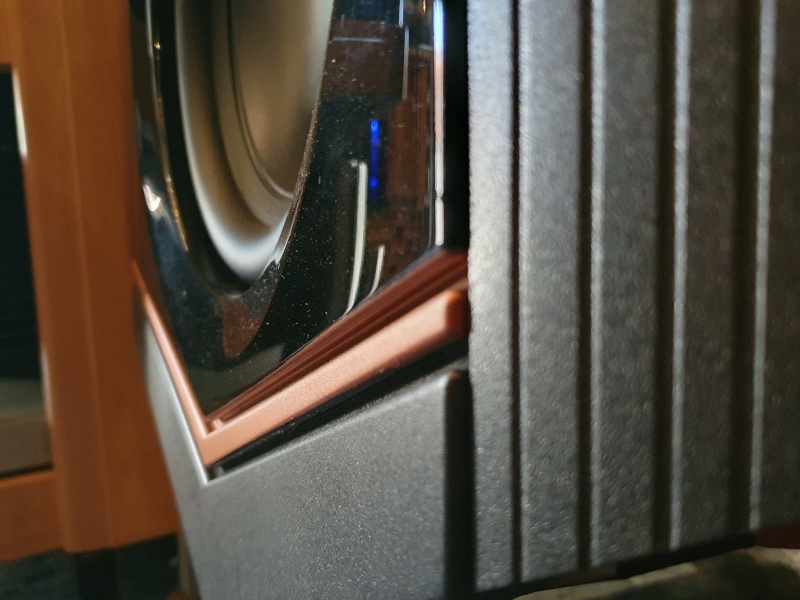
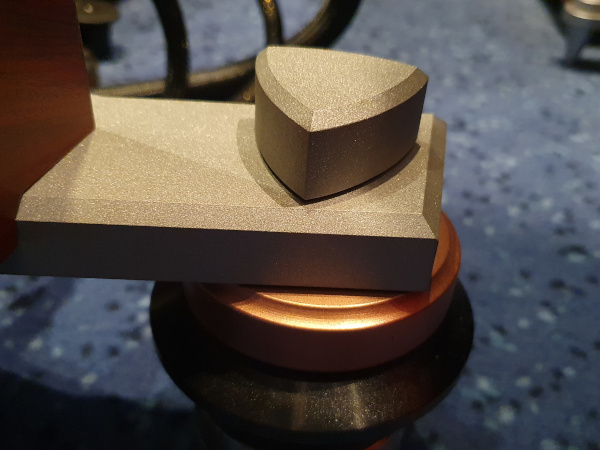
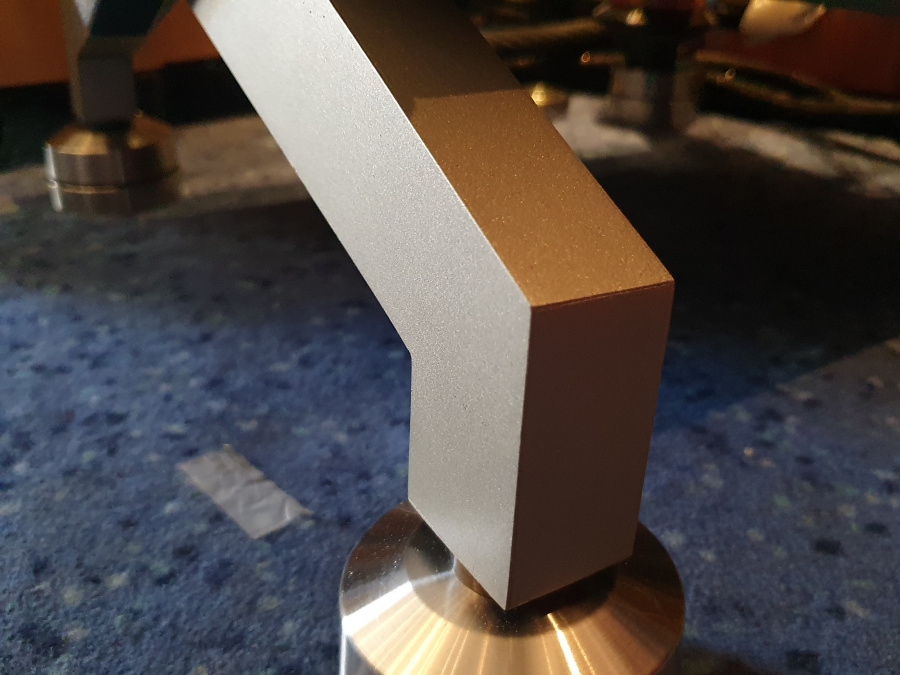
The V system is not your next Sonus Faber. It was designed to perform, not to aesthetically please. I can hardly imagine that someone will find this Legacy beautiful, and the precision with which the individual parts are assembled in Guggenheim fashion and how well they fit together raises some questions. Also, the LED light decoration may be attractive for shows, not for home listening. On the other hand, it is a very unique loudspeaker with totally mind-blowing performance. I yet need to hear a speaker that would match the Legacy’s V realism, immediacy and soundstage accuracy. In this sense, it is a sonic tour de force, an audio industry disruptor that sends many other manufacturers back to the kindergarten.
Function and form
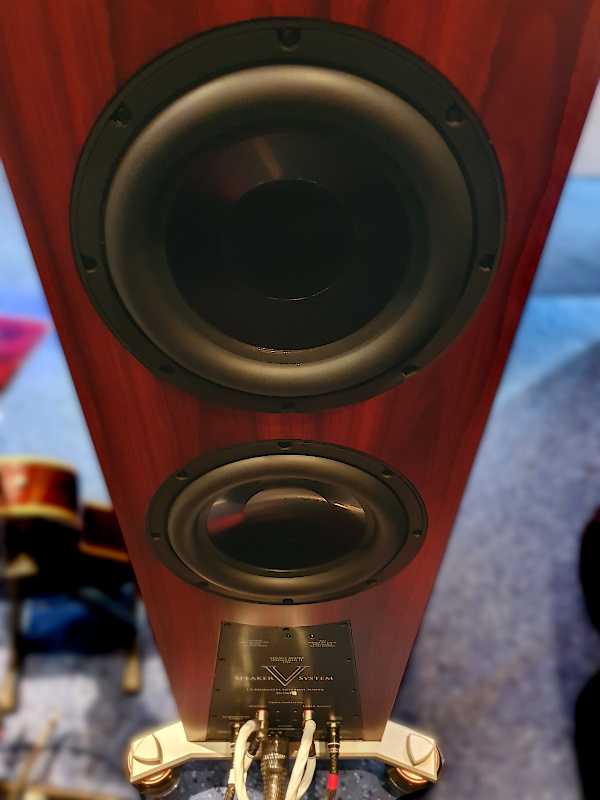
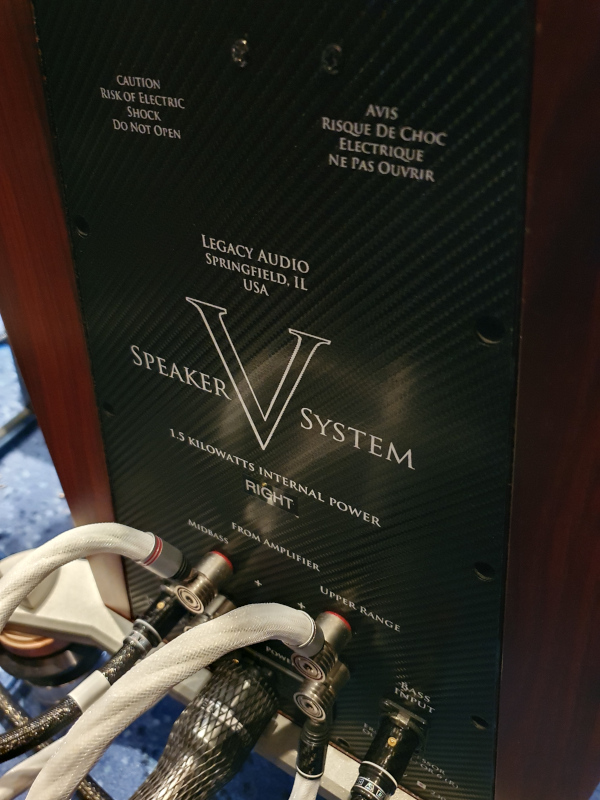
In standard technical terms, the Legacy V system is a semi-active 4-way speaker with specified frequency response 16Hz – 30kHz (+/-2dB), low nominal impedance of 4 ohms, and high sensitivity of 98dB. The latter two only apply to upper mid/treble section as the bass section is powered by built-in ICEpower Class D amps (500W for upper bass, 1000W for lower bass).
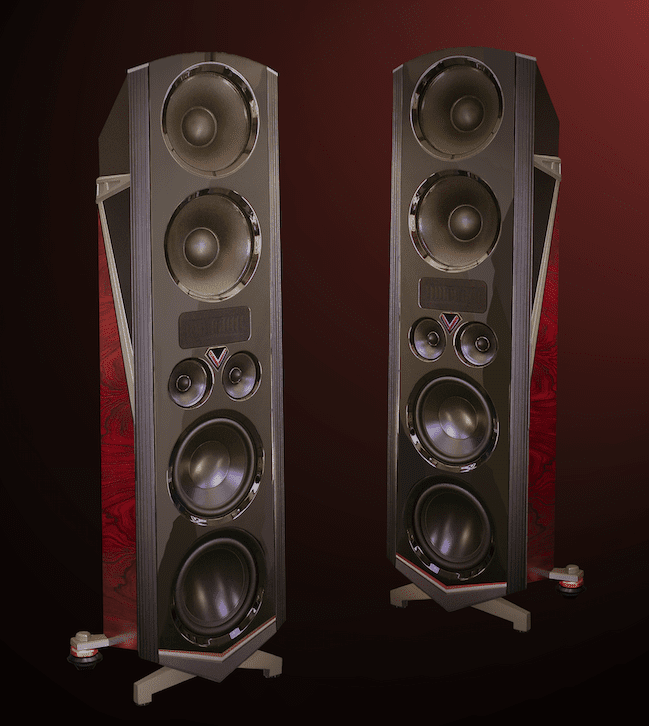
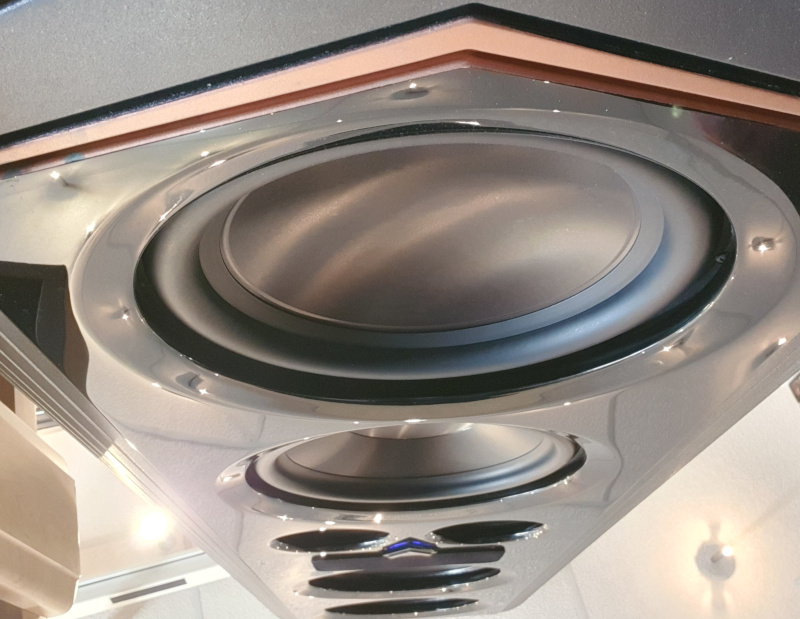
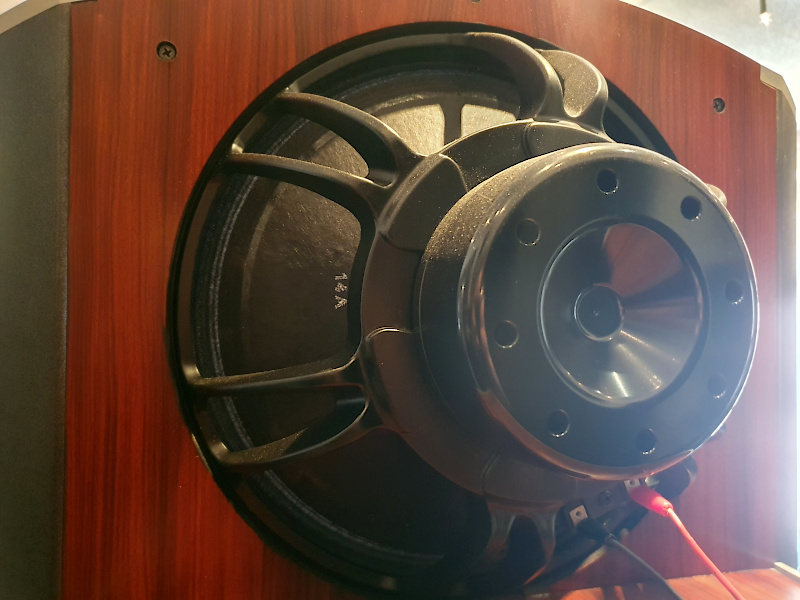
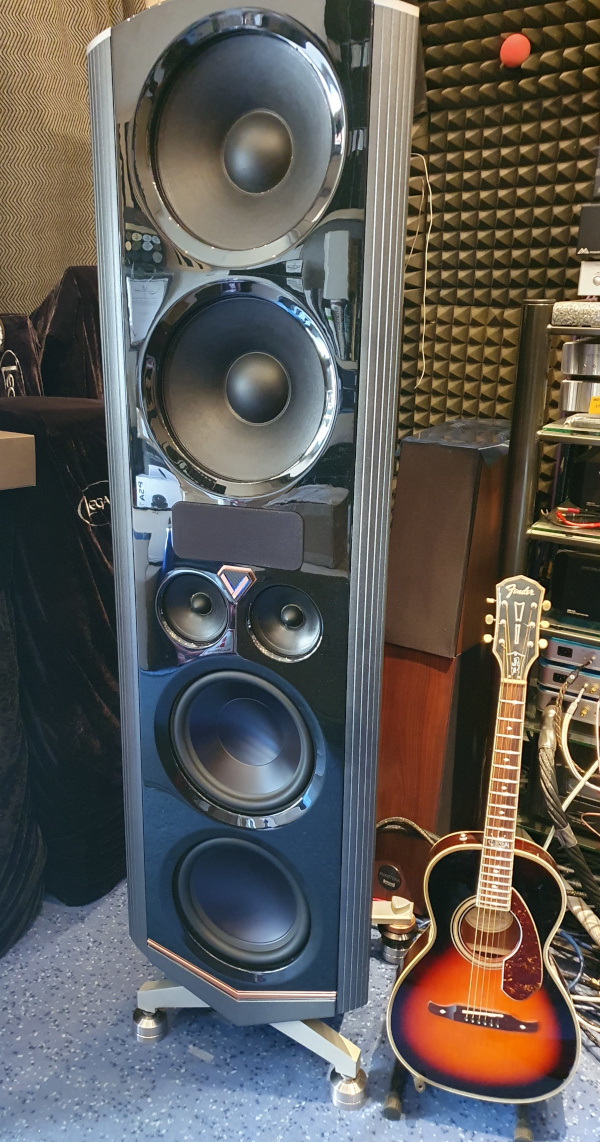
This Legacy is a 8.3 dipole system. The bass is handled by 2x 30cm active drivers with milled aluminium cones, plus there are 3x26cm passive radiators. Legacy says the combined output of these drivers controls the cardioid pattern of the bass radiation to suppress colorations added by a room.
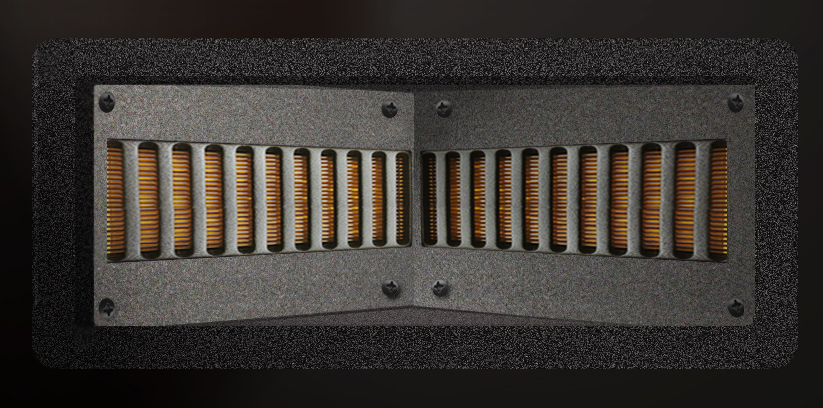
The midrange is represented by 2x 15cm drivers for lower treble/upper mids and 2x 35cm drivers for lower mids/upper bass. For the top range, there are 2x 10cm AMT (Air Motion Transformer) ribbon tweeters, arranged in a horizontally concave V-shape, so their acoustic axes meet in front of the baffle. Hence the “V” name of the speaker. Similar arrangement (yet more sophisticated) can be found in the Legacy’s flagship Valor speakers. Because of the dipole design, there is no “cabinet” as such, rather a framework and a baffle board. Considering the number of heavy motors and the size of the speakers (183 x 48 x 48cm), each tower of the V-system is surprisingly light with only 100kg per unit.
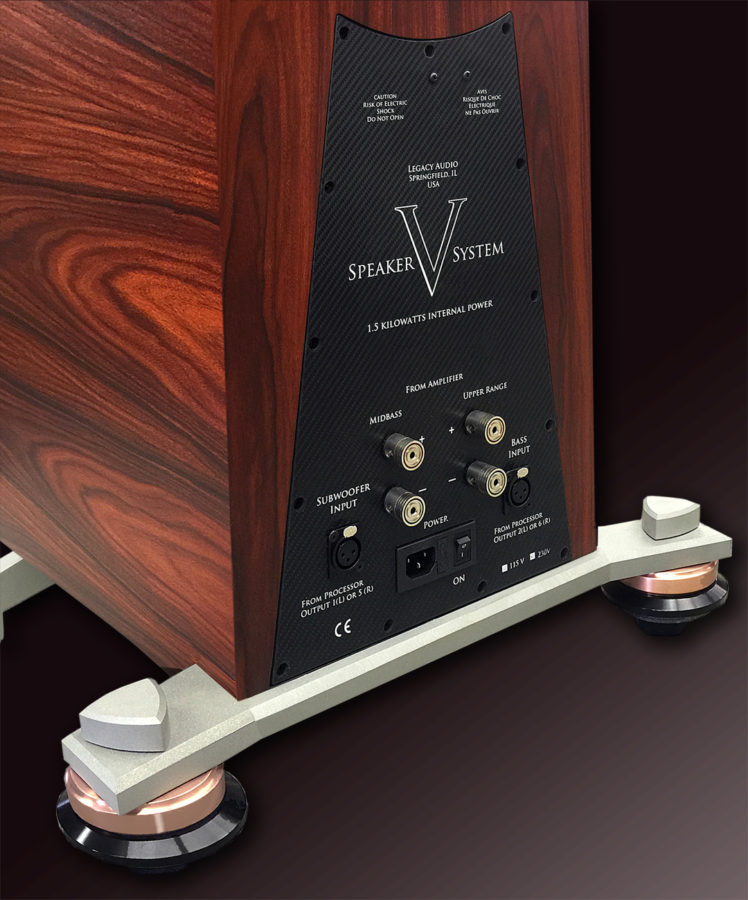
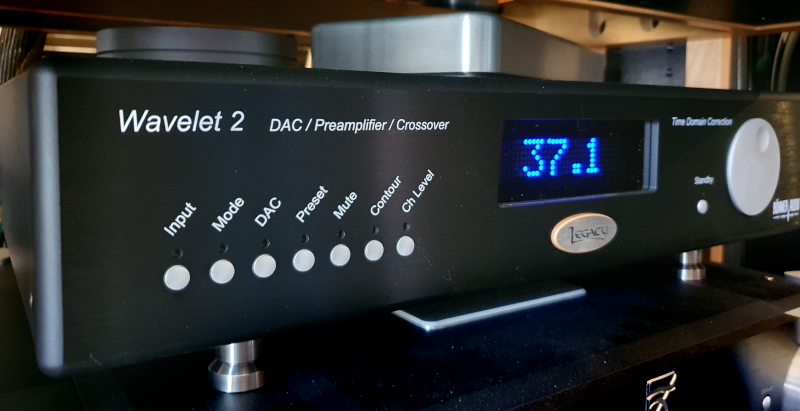
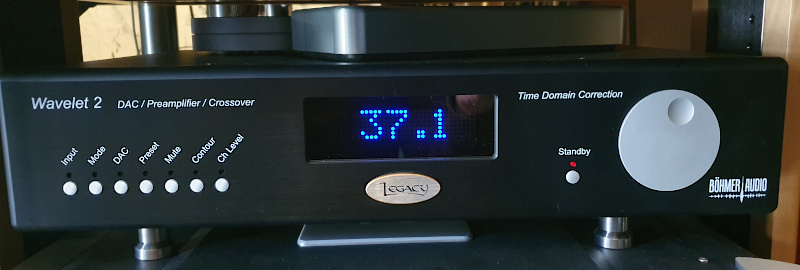
Each band is separate, so, to drive the V system, you’ll need two external amplifiers, plus there are the aforementioned two that are already inside each speaker. That is a four amps powerhouse. Luckily, you won’t need a preamplifier, for the Wavelet II processor of Boehmer Audio design, that comes with the speakers, sits in the heart of the V system and controls all its vital functions. It combines a DRC with 62 bits of depth / 96 kHz with a microphone input (cable included), a digital crossover, a DAC (USB, coaxial, and optical inputs), and an analogue preamplifier (2 x XLR and 2 x RCA inputs, 4 x XLR and 4 x RCA outputs). The external power amplifiers are connected via binding posts. They don’t need to be particularly powerful as they only drive the top end of sensitive speakers; the internal amps are fed via XLR inputs. The whole system wiring scheme is quite complicated and the best you can do is to let the distributor set the speakers up for you, as you will also need to access Legacy servers.
Bass management
It would be a mistake to think that the Wavelet is a digital room correction device – it is only a fraction of what it does. In essence, this engine is there to uncover the naked program material (music) as it was encoded on a disk or in a file by ultra-precise alignment of drivers in frequency and phase, and by reducing the impact of the room, especially the reflected sound and phase shifts are heard as colorations. In the abbreviated excerpts, taken from The Absolute Sound interview, Bill Dudleston explains the concept.
On the tweeters: The outside edges [of the tweeters] were brought forward in increments, allowing the ribbons to crossfire. The center summation was quite solid, as it should be, but an added benefit was the mutual coupling at the lower end of the ribbons’ range, increasing efficiency and decreasing distortion even further. If the ribbons were not splayed as described, they would comb filter at higher frequencies. But because the diaphragm is moving away from the listener as it approaches the center, combing is not a problem. Ironically, the 6″ drivers just below the ribbons intentionally rely on destructive interference off-axis to reduce their level.
On the dipole: The primary reason [to use it] is as a steering mechanism. The technique provides better transient behavior and more snap. The goal is to reduce the angle of sound radiated in the room. The dipole by nature creates acoustic nulls to each side. It also radiates out-of-phase energy to the rear so that the rear reflections do not add constructively to the front radiation. In the midbass range the rarefaction of the dipole erodes the undesired bass leakage to the rear from the upper bass driver. As with microphones, an omni and a figure-of-eight combine to form the desired cardioid pattern, rejecting rear energy.
On the crossover parts: Generally, improved resolution and transient response are the most obvious benefits of connecting a speaker driver directly to the power amplifier. Component losses are eliminated, and crossovers are much more precise. Even with the best quality passive components, there is a small degradation of sound for every component you put between the power amplifier and the speaker driver. Even a simple inductor adds resistance. The real benefit of eliminating passive crossover is that the passive filters are impedance-dependent by nature, which is reducing amplifier headroom.
On the time corrections: It’s all in the timing. The sound of music is created by varying air pressure over time. Ironically, it is in the time domain that we find the real solution to the problem. It is the combining of multiple arrivals that cause problematic response dips and peaks. The room is dominating the decay of power. As a result the anechoic “flat” speaker may exhibit boominess or muddiness, and transient hangover. Attempting to equalize the response without regard to the time domain will actually compound the response errors at other points in the room while creating new time domain errors at the listener position.
[The Legacy] algorithm relies on psychoacoustic weighting (how we hear) and how the sound sequentially arrives to us. The applied correction is not sensitive to position. Transient behavior is improved on- and off-axis. The measurements [by microphone] are exported to a dedicated website where a super-computer performs many thousands of iterative calculations to determine the optimal correction solution. After the correction algorithm coefficients are rendered for each speaker and automatically downloaded into the processor, the processor can apply the correction in real-time over a full 40ms window. Psychoacoustic weighting is emphasized in the calculations. The time domain is not compromised to fill minor dips in the response curve. The time-corrected response is always smoother but never ruler-flat. The bass will be deeper with faster decay. Vocals will be full, but not chesty or weak from the floor bump and dip that nearly always occurs. Sonically this translates to a more natural transient. If an actual drum is struck, the initial sharp transient pulse will be felt as well as heard. Conventional speakers without controlled directivity and proper room correction can smear the event in time, compromising tautness. This is readily evidenced by defeating the room correction, even on the highly controlled V system.
On the frequency corrections: We have learned that notch filtering of resonances is not a solution. When a dip is boosted in the power response, so is the reflection that caused the dip in the first place. Amplifier power is wasted, the speaker works harder, and the time domain is corrupted. Many of the nulls and buildups we experience are not from resonances at all, but instead from reflections interfering with the direct path to the listener. Remember that multiple reflections are required to create a resonance, so the time required for them to generate is significantly longer. Resonance and reflection behavior is quite different and should be treated accordingly. Automated equalization of the power response is treating a symptom, not the cause.
A chief problem in correction systems lies in the unevenness of sound throughout the room. It originates because of the way correction systems treat the different resonant phenomena within the room. They tend to disregard the origin of the resonance, treating them all in an equal manner. This is a mistake because resonances with different origins have radically different behavior. The Bohmer method captures the wavefront as it is building in time. It collects a more useful and accurate sample over a longer period and distinguishes between direct sound, reflections, early resonances, and later resonances.
Clarity & delicacy
The number of drivers and the size of the V system logically implies that these speakers are for all but small rooms. However, any large room will inevitably introduce plenty of reflections and resonances that – if not properly treated – will translate negatively into the sound of the system. The farther the listener sits and the closer he or speakers are to the room boundaries, the more problems can be expected. The experience shows that for the Legacy V system, the optimum listening distance is about 4-5 meters, which makes a lot of sense. However, I auditioned them in the importer’s rather small room that placed me just 2 meters from the tweeters and the speakers just 1.5m from room boundaries. It is close listening by any standards. Although the logic and intuition says it cannot work, after adjusting all the available Legacy settings the result was mind-blowing.
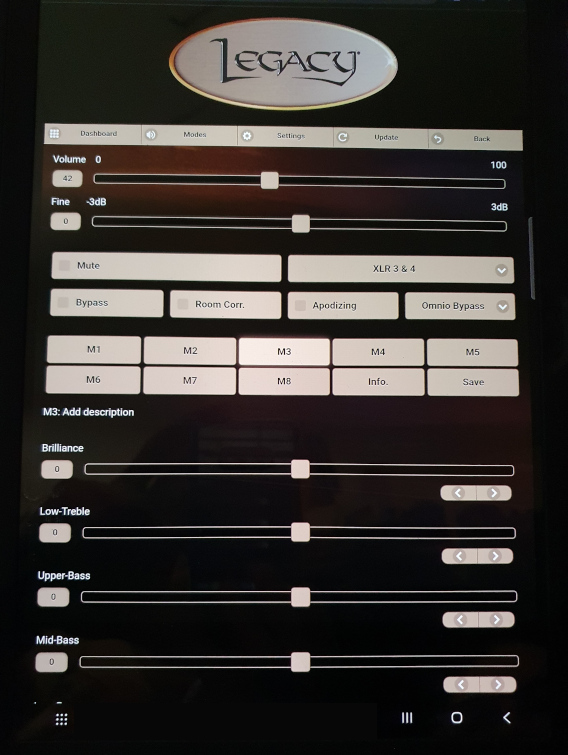
All critical filters, phases and crossover behaviours are set by factory. In Legacy, they do it for each speaker separately as well as they calibrate the complete pair, so the customer receives a fine-tuned pair of speakers. Don’t touch these settings. If you do, you will tune the speakers out. What you can do, is to use a tablet with Legacy’s app which is strongly inspired by pro-audio. There you can adjust the speaker’s sound to your taste and to your listening environment. It happens via sliders like on a mixining console, marked as Brilliance, Low Treble, Upper Bass, Mid Bass, Low Bass and Punch. The slider have no markings but the numeric values of the settings is shown so it can be put down on a sheet of paper or, ideally, saved in one of the 8 memory banks of the app. Before and after comparisons can be run easily via a bypass button. The volume uses a two-step control: one slider controls the gross adjustments, another fine steps. Again, this is quite common in pro-audio. The settings are powerful and makes tuning the V system to any room and preferences possible. As usual, less is more so work light-handed for the best results.
Tonal accuracy
I find the brutal transient dynamics to be where the Legacy V really do stand out. I don’t know of any other loudspeakers that can deliver transients as precisely and with such an impact as the V-series. I attribute part of this to the fact that you’re pumping watts into the V system with four amplifiers, however the main credit goes to the perfect tuning of the crossover filters. As a result, the guitars in John Pattitucci’s Another World, for example, reach my ears with such an immense amount of energy and in such a realistic form that it is breathtaking. The Legacy V has nothing like a quiet or black background; it’s as if there were no background at all—suddenly, the depth of a studio, club, or concert hall in all its glory appears in the room; you hear no attempt to reproduce it — everything is terrifyingly realistic.
In another standout track, George Duke’s After Hours, the kick drum and the bass are delivered to the ears with such explosive force and immediacy that it almost contradicts everything I’ve believed home audio is capable of. The main limitations of a music event reproduction usually connect to dynamics and timing; these two are the consequence of how the drivers and cabinets (as well as associated electronics and cables) are aligned in the frequency domain but, even more importantly, how their impulse characteristics and latencies are matching without being ‘off’ by a fraction of cycle. The task for majority of loudspeakers is to achieve this alignment in 2 or 3-way design with 2-5 drivers in total. It’s already a nightmare. The challenge is like getting a subwoofer undelayed in phase—it’s just not going to happen unless you employ smart ways of sound processing for main speakers to achieve time-coincident playback. 99.9% of audio (and video) enthusiasts have it wrong. However, if you succeed, you’ll suddenly hear music like never before. The bass immediacy and dynamics will be a completely different level. With the Legacy V, there are 11 drivers, 8 active and 3 passive, to be perfectly aligned. And the goal was achieved. The result is incredible single-band-like coherence, where even with the system’s substantial size, you can’t tell which driver compartment the sound is coming from, and with your eyes closed, you can’t even tell where the towers of the speakers are located in the room.
One remark, though. I’d be curious to hear how the V system would sound with a dome tweeter instead of AirMotion ribbons; at times they seem a bit harsh to me, though they project sound into the room with great energy and, I must admit, that they give you a sense of volume and weight (yes, even the highs can have volume). A cymbal, struck by sticks or brushes, thus has a physical body; it is a piece of three-dimensional metal in space, resonating with lifelike proportions.
Spatial resolution
One of my benchmarks for sibilance—Alison Krauss’s Away Down The River—requires a carefully balanced system so the sound isn’t matte or overly bright; it is so easy to hear this track opaque or too grating on your ears. In typical audiophile setups, I tend to hear the latter, and the music then sounds shallow and the vocals thin, lacking body and substance. With the Legacy V, it was fine, and it was better than with the Legacy Aeris and Whisper XD, which I listened to under very comparable conditions.
Another woman and another great track: Diana Krall and Devil May Care from her Live in Paris concert album. What can you hear through the Legacy V? Fingers running from left to right across the keys, just as captured by the microphone peeking under the open soundboard of the Steinway. The singer’s voice, which is lifelike and flawless. It’s not about any “as if she were standing right in front of you.” She is there, and when you move your head, you can almost feel a breeze of perfume from her flowing hair.
I’m not mentioning any classic rock hits, because with any Legacy, this is a category of its own. You won’t find anything better. The Legacy V is a very special system. As said, it’s not about looks but about function; it is offering immense adjustability, and despite its complexity, the V system is easily adaptable to a wide range of listening situations. So, the question isn’t whether it’s suitable for your space—it’s just a matter of good integration in your listening environment.
Our favourite artists, who have shaped the face of popular music over the past few decades, are slowly but surely leaving us and they will never be back. The Legacy V is the only tool I know with which you can bring them back to life, right in the center of your living room.
Recommended resellers
Platan Audio, Hlohovec / Bratislava, tel. +421 905 409 802
Manufacturer's website: http://www.legacyaudio.com
Associated components
- Sources: Antipodes Oladra streamer, Silent Angel NX switch + GX clock + FX PSU, Legacy Audio Wavelet II processor, MSB The Discrete DAC + two external PSU modules (analog a digital)
- Amplifiers: Simaudio Moon 680A V2 power amplifier (lower mids and upper bass), Coda 16.0 power amplifier (upper mids and treble)
- Interconnects and speaker cables: Stealth Audio Metacarbon and Sakra, Dream V18, Dream V14, Synergistic Research Galileo SX, Synergistic Research Galileo Discovery AES/EBU and Atmosphere Excite LAN
- Power conditioning: Synergistic Research Galileo Powercell 12 UEF SE, Synergistic Research Galileo SX and Atmosphere Excite, Stealth Audio Cloude Grande and 20-20
Gallery


ACOUSTIQUE QUALITY AQ Passion
Acoustique Quality has been around since early 90’s. The company’s loudspeakers were always close to what can be characterized a good value for money, with a bit of pre-2000 vibe. Speaker by speaker the guys in Acoustique Quality ...
Recommended resellers
AQ s.r.o., Červenka, tel. +420 585 342 232
ANTE Supersonic One
The Supersonics were visually inspired by Lamborghini Countach racer. The functional elegance of the Lamborghini does not come at budget costs and neither the Ante does. The price tag of €160,000 keeps the Supersonics in the company ...
Recommended resellers
Media Control, Bratislava, SK, +421 905 613 928
AQ Canto 5
An experience that moves your soul. This is how Czech loudspeaker manufacturer presents the brand-new Canto range. For the company, the Canto is a milestone, so important that they decided to dedicate a special website to it. The ...
Recommended resellers
AQ s.r.o., Červenka, tel. +420 585 342 232
AUDIO PHYSIC Avantera
The Audio Physic’s HHCM midrange drivers are fantastic. The realism of both male and female vocals through the Avanteras is nothing short of magic. The Avanteras skillfully blend a cocktail full of colors, sonority, textures, ...
Recommended resellers
CZ: High-End Audio Studio, Praha, tel. +420 224 256 844
SK: Platan Audio, Hlohovec / Bratislava, tel. +421 905 409 802
AUDIO PHYSIC Cardeas Plus+
Audio Physic's original Cardeas was like an album of a respected band that was recorded just because it had to be recorded due to a contract. Not like the album that was recorded because the band wanted to. I sighed with relief that ...
Recommended resellers
CZ: High-End Audio Studio, Praha, tel. +420 224 256 844
SK: Platan Audio, Hlohovec / Bratislava, tel. +421 905 409 802
AURUM CANTUS V6F
The Aurum Cantus V6Fs have the ability to dissapear from your ear-view - they move an orchestra to your living room instead and let you bathe in an expanding and transparent soundstage. After listening to the V6Fs you'll find ...
Recommended resellers
Hifi studio MeLissa, Brno, tel. +420 777 04 1313
AVANTGARDE ACOUSTIC Uno Fino
Should your priority is to blend the speakers with your interior and make them visually disappear, the Avantgarde Acoustic Uno Fino is not for you. I am not in favor of color lacquers on speakers and prefer natural veneers where ...
Recommended resellers
HI-FI studio TYKON, Ostrava, tel. +420 723 449 894