SHUNYATA RESEARCH Sigma-X
Interconnects
The Sigma-X does not manufacture intimacy. Instead, it preserves separation, texture and proportion, giving the presentation a controlled, studio-like clarity. It is and an unusually transparent, precise and unobtrusive reference cable.
Function and form
According to Shunyata Research, Sigma-X analogue interconnects use ultra-pure OCC copper conductors, PTFE dielectrics and precision-braided shields. The company groups these manufacturing controls under its PMZ (Precision Matched Impedance) concept: conductor surfaces, dielectric extrusion and shield geometry are held to tight tolerances, with extrusion and braiding carried out at one quarter of normal production speed. Whatever one thinks of the terminology, the underlying objectives are sensible—consistent geometry, stable electrical behaviour and lower susceptibility to noise.
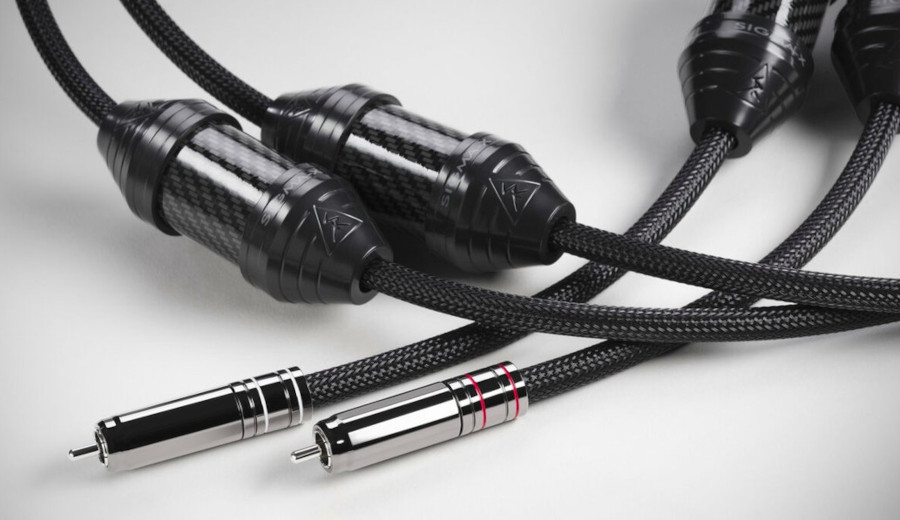
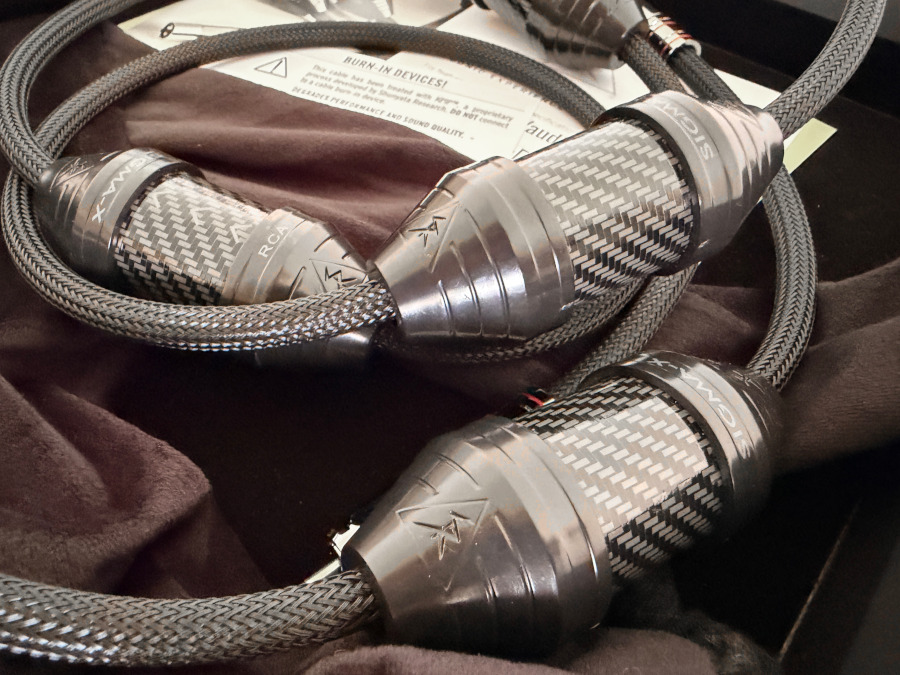
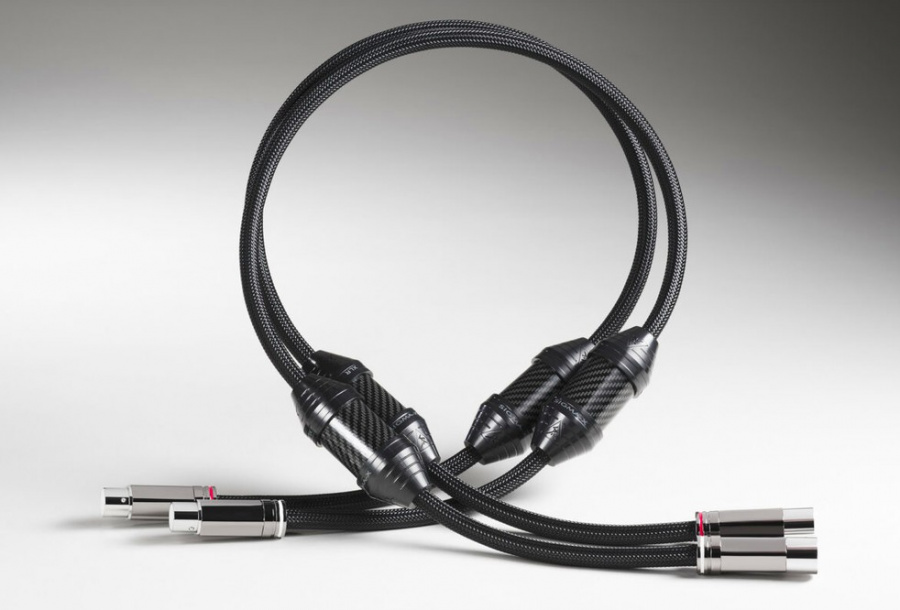
The most visible feature is the TAPc module. Shunyata describes TAPc, or Transverse Axial Polarizer, as a passive element that couples to the electromagnetic field around the signal conductors and reduces field-related distortion perceived as glare or compression. Sigma-X also receives the company’s four-day KPIP v2 conditioning process, intended to reduce the usual settling period. These claims are difficult to isolate from the complete cable in a domestic listening test, so I would not pretend to verify the mechanism independently. What I can assess is the result: low apparent noise, clean timing and very little added emphasis.
Bass management
During my time with Shunyata Research’s Sigma-X, I was able to compare it directly with three other interconnects: Ansuz Signalz C2, Gryphon Vanta and KrautWire Max-S. These are all serious cables, but they approach lossless signal transmission very differently. The Shunyata and Ansuz use copper conductors with fluoropolymer insulation (PTFE), while the KrautWire uses silver-plated copper and the Gryphon a silver-gold alloy, also in PTFE. Each is well shielded, yet differences in conductor material, geometry, dielectric and termination translate into clearly distinct presentations.
In one sentence each, the Max-S sounded the most robust and energetic, but also slightly heavy-handed; the Vanta was the quietest and the richest sounding; the Ansuz was the most explicitly detailed and “audiophile”; and the Sigma-X was the cable that disappeared most convincingly. That last quality defines the Sigma-X. Its character is a relative absence of character: it does not push tonal richness, treble sparkle or bass mass to the foreground, but instead combines neutrality, speed and organisation in a way that makes the system—not the cable—the main event.
Clarity & delicacy
Bass is not presented with exaggerated weight. Compared with the KrautWire, the Sigma-X can initially seem leaner, but its low frequencies are more precisely outlined, faster and more articulate. Leading edges are firm, pitch definition is excellent and complex bass lines remain easy to follow. Macrodynamics are convincing: large changes in level arrive without hesitation and have real punch. The cable is slightly less exceptional in the smallest microdynamic gradations, where some competitors can reveal more of the pressure and phrasing within a sustained note.
The midrange is neutral and notably free from the warm, softly saturated colour sometimes associated with copper cables. Voices are exceptionally legible, with clear diction and stable placement, but they are not sweetened. In some systems this honesty will be exactly right; in others, especially those already voiced toward coolness or restraint, listeners may prefer the richer tonal density of other interconnects.
Treble performance follows the same pattern. The Ansuz can sound more spectacular in an immediate comparison because it draws fine information more explicitly; the Sigma-X is less demonstrative and more integrated. Its strength is coherence: detail belongs to the instrument and the recording rather than being presented as a separate effect. It should be, at twice the price of the Ansuz.
Tonal accuracy
Despite the shielding, placement mattered in my system. Unless monaural amplifiers are used, the left and right interconnects often leave and enter components in parallel and may run close together behind the rack. Changing how the two legs crossed, touched or followed power cables produced small but repeatable differences. This is not a reason for anxiety, but it is worth arranging the cables carefully, avoiding tight coils and unnecessary contact, and then leaving them undisturbed before making a final judgement.
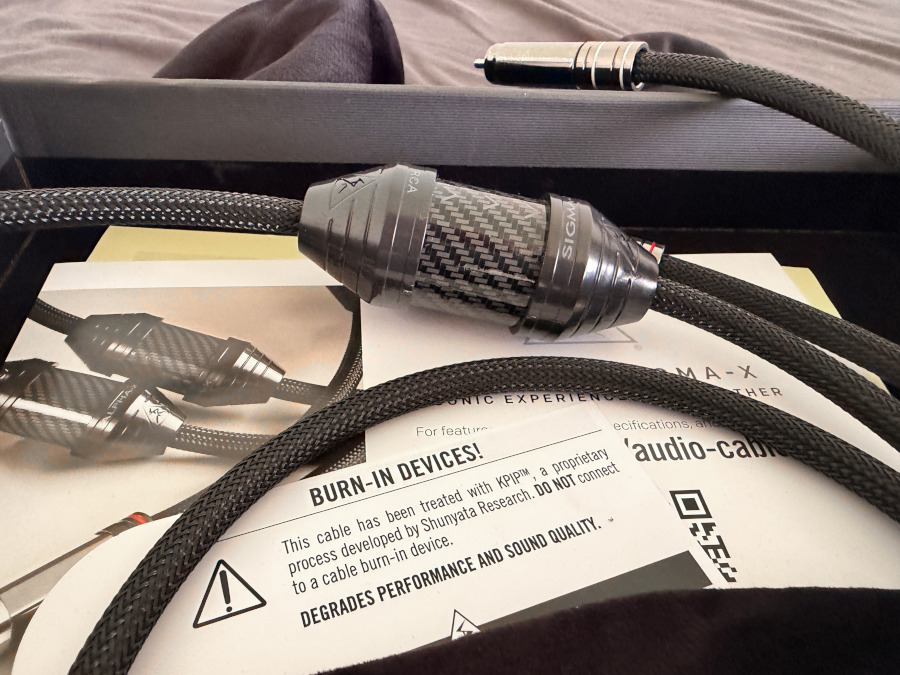
Shunyata advises against treating the cables on third-party burn-in machines because Sigma-X is factory conditioned by KPIP v2. In my system, the TAPc modules also seemed to need a short period after reconnection to settle. This was not a matter of days: after roughly 20–30 minutes the presentation became more transparent, textural resolution improved and image depth was more convincing. Rapid swapping therefore risks understating the cable’s performance; level-matched comparisons with a reasonable pause were more useful.
Spatial resolution
Sigma-X is an excellent interconnect: fast, neutral, controlled and unusually unwilling to impose a signature. Its bass precision, spatial stability and lack of glare are reference-level qualities, while its restraint makes long-term listening easy. It is not, however, the best cable in every respect or for every system. Some competitors offer greater tonal saturation, more vocal sweetness, stronger low-frequency weight or finer microdynamic expression. Those differences are not automatically more accurate, but they may be more satisfying in a particular system.
That balanced conclusion also makes me curious about Shunyata’s flagship Omega-X. The manufacturer adds Ohno continuous-cast conductors, platinum-plated connectors and its patented ΞTRON electric-field compensation technology, alongside a more advanced application of TAPc. On paper, these changes target precisely the remaining areas where Sigma-X leaves room for improvement: tonal authority, low-level expression and the sense of unrestricted ease. Sigma-X sets a very high standard, but it also suggests that Shunyata’s top model may have something genuinely worthwhile left to reveal.
Recommended resellers
TYKON, Ostrava, tel. +420 723 449 894
Manufacturer's website: http://www.shunyata.com
Associated components
- Sources: Accuphase DP-720
- Amplifiers: TAD-M2500 MkII
- Interconnects and speaker cables: Ansuz Signalz C2, Krautwire Max-S, Gryphon Vanta, Audioquest Dragon Bass | Zero
- Loudspeakers: TAD Revolution One, Sonus Faber Gravis subwoofer
- Power conditioning: Shunyata Research Denali, Ansuz Mainz C2, AAI Maestoso, AAI Estremo, Synergistic Research Atmosphere Level 2, Synergistic Research Euphoria Level 3, Stromtank S1000
Gallery
AAI Estremo
I tasted the all new Estremo range last year, on two remarkable occasions. The first involved a Guarneri violin and a Fazioli concert grand, the second involved my own TAD Revolution One loudspeaker project that I have thoroughly ...
Recommended resellers
AAI (Authentic Audio Image), Povážská Bystrica, +421 905 694 943
AAI Maestoso IC
Out of all those interconnect cables that my audio system has ever hosted, the Maestoso interconnect reminded me Nordost´s Odin the most. I mean the original Odin that sold at 16k€ per meter. Certainly, there were some nuances, like ...
Recommended resellers
Authentic Audio Image, Povážská Bystrica, +421 905 694 943
ANALYSIS PLUS Copper Oval-In
Analysis Plus Copper Oval-IN (1m XLR) brought up images of a hornet to me. There was nothing hornet-like in its sound, rather it looked exactly like it with its black and yellow camouflage. Contrary to a hornet the Copper Oval-IN is ...
Recommended resellers
Audiostudio s.r.o., Olomouc, tel. +420 608 752 475
ANALYSIS PLUS Silver Oval-In
After many computer simulations and other exhaustive tests, in Analysis Plus they determined that a hollow oval cable constituted the best possible conductor design. The primary advantage of an oval conductor design rather than ...
Recommended resellers
Audiostudio s.r.o., Olomouc, tel. +420 608 752 475
ANSUZ Signalz C2
The design goal of Ansuz Acoustics is to keep inductance as low as possible. The Ansuz interconnects are using three twisted 3 mm coaxial cables (Direct Ground Connection alias DGC), and 2x6 wires twisted in reversed directions to ...
Recommended resellers
RP Audio, Ostrava, +420 737 366 831
ANSUZ Signalz D2
Like the Ansuz Signalz C2 is the Signalz D2 a showpiece of modern technicistic design of interconnects. The black and grey of braid is complemented by translucent copper that gives the cable its depth of colour and premium look. Like ...
Recommended resellers
RP Audio, Ostrava, +420 737 366 831
AUDIOQUEST Thunderbird
After years of hiatus, AudioQuest has finally decided to shift the attention to signal cables. It could have been an upgrade, but it is not: the new range of interconnects turns most cable-building principles upside down. There is ...
Recommended resellers
AQ s.r.o., Červenka, tel. +420 585 342 232